

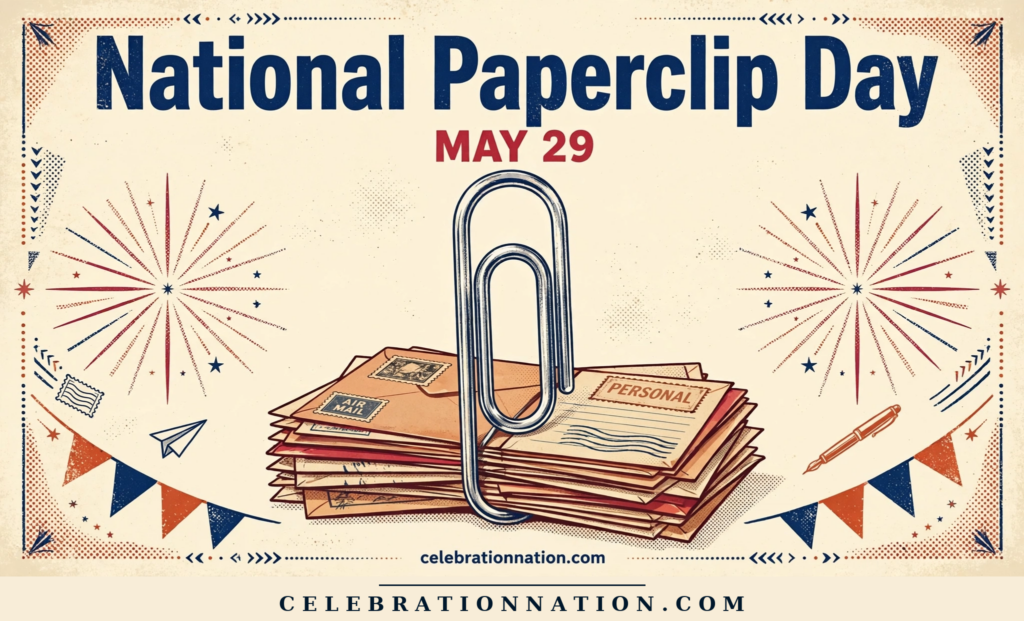
National Paperclip Day
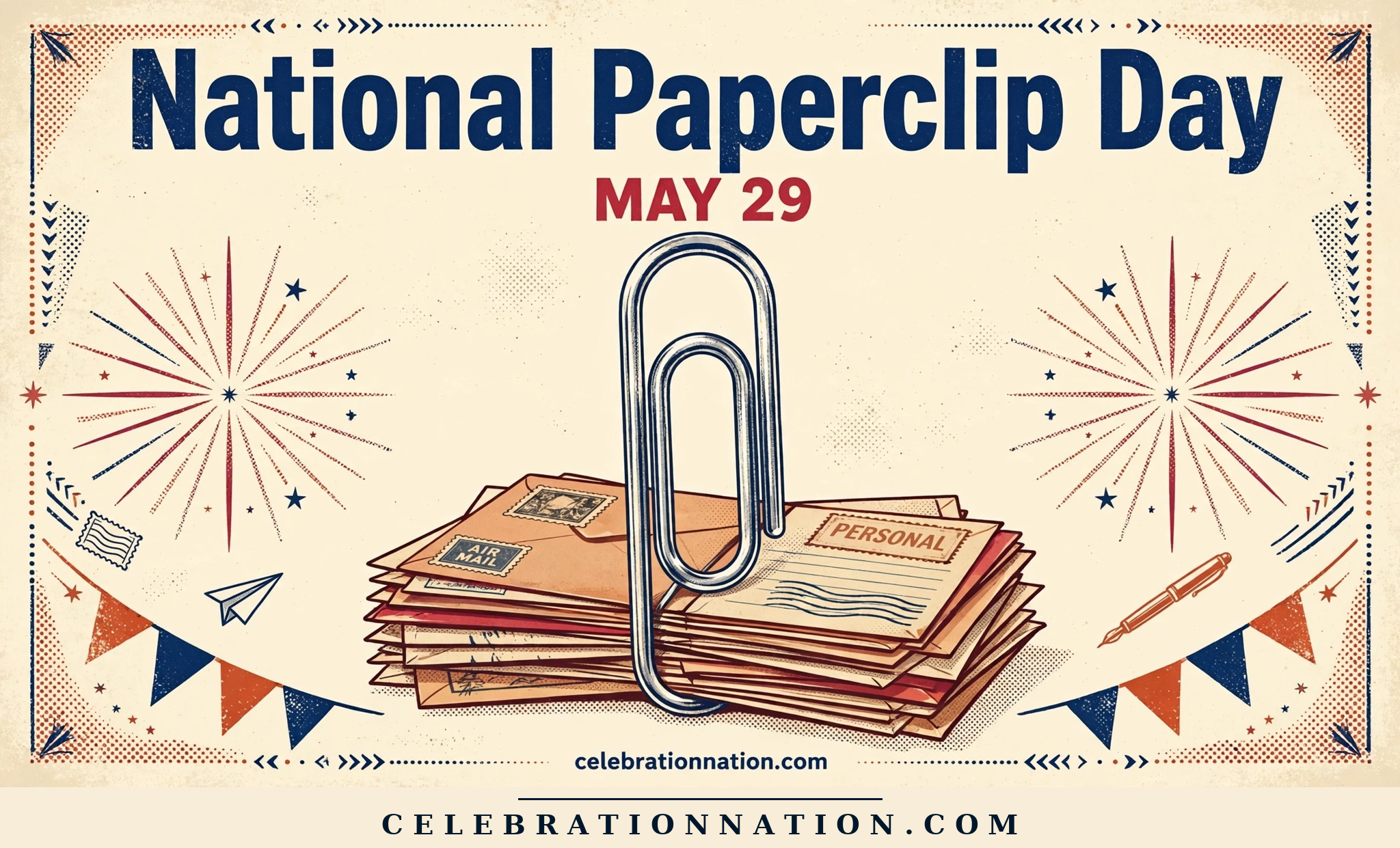
National Paperclip Day on May 29 honors one of the 20th century's most perfect industrial inventions — the humble paperclip. Patented in 1901 by William Middlebrook of Waterbury, Connecticut, the Gem paperclip's double-loop design has gone unimproved for 125+ years. Simple, cheap, ubiquitous, it's the rare object whose perfect form was locked in on first design. Even Office XP's Clippy (1997-2007) was an homage.
- Vibe
- Humble Perfection
- Also on May 29
- International Day of UN Peacekeepers · 529 Day · Coq au Vin Day
- Hashtag
- #NationalPaperclipDay
Ways to celebrate
Appreciate the simple:
- 📎 Use a paperclip mindfully. Next time you clip papers, appreciate that the design hasn't been improved in 125 years.
- 🎨 Make paperclip art. Kids and adults alike can make simple paperclip sculptures. Amanda McCord's 'Paperclip Chronicles' site has project ideas.
- 🎬 Watch 'Paper Clips' (2004). Documentary about a Tennessee school that collected 6 million paperclips to represent Holocaust victims. Remarkable story.
- 📚 Read 'The Evolution of Useful Things.' Henry Petroski's classic on industrial design — includes a chapter on the paperclip's history.
- 🇳🇴 Read about Norwegian Resistance. The WWII paperclip symbol is one of the most meaningful in 20th-century resistance history.
Make it your kind of celebration
Family
Paperclip art is a classic family rainy-day craft. Simple jewelry, sculptures, chains. Paperclips are cheap and safe.
Kids
Paperclips are a rite of passage — kids eventually bend them, straighten them, make chains. A gentle introduction to material culture.
Couples
Read 'Paper Clips' story together. Or watch the documentary. Quietly moving.
Office
Office paperclip day — notice the office supply you use most. Small appreciation of the everyday tool.
School
Classic school supply — basic writing tools lesson. The Whitwell Paper Clips Project (Tennessee school, 1998) is a remarkable Holocaust lesson.
Community
The Whitwell Paper Clips Project (1998-2001) — 6 million paperclips collected — is a worthwhile community education initiative.
Just me
Quiet appreciation of mundane-good-design. Read Petroski. Reflect on perfect invisible objects.
Plan ahead
National Paperclip Day is observed on May 29 every year. Here is where it lands for the next ten years, handy for planners, marketers and party people.
Fast facts
The story
The modern paperclip, the 'Gem' design of two interlocked loops, has a murky origin. William D. Middlebrook of Waterbury, Connecticut patented a paperclip-bending machine in April 1899; his 1901 patent covered the machine, not the paperclip design itself. The Gem paperclip shape appears to have existed before the patent, possibly developed by an English company, Gem Manufacturing, in the 1890s. The design has been called 'one of the most perfect industrial designs ever', it cannot be improved on. It's cheap to manufacture, reliable, reusable, and performs its function perfectly.
Read the full story
A Norwegian named Johan Vaaler patented a different paperclip design in 1899, often incorrectly credited as inventing the paperclip. Vaaler's design was inferior (single loops, not double); the Gem design dominated globally. Norway embraced the paperclip as a national symbol anyway. During Nazi occupation of Norway (1940-1945), Norwegian resistance fighters wore paperclips on their lapels, a subtle symbol that fellow Norwegians understood to mean 'we stick together.' Wearing a paperclip could result in arrest by the Nazis. The symbol has endured in Norwegian memory.
In 1998, a Tennessee middle school launched the Whitwell Paper Clips Project, collecting 6 million paperclips to represent the 6 million Jews murdered in the Holocaust. The project inspired the 2004 documentary "Paper Clips" and built a Holocaust memorial housed in an authentic German railcar (the same kind that transported victims to death camps). The Whitwell project continues today and has received global attention. It's one of the most moving Holocaust education efforts in American history.
Microsoft's 'Clippy' (Clippit), an animated paperclip help-assistant in Office XP (1997-2007), was a controversial Microsoft feature. Users generally disliked Clippy's intrusive suggestions; Microsoft retired the character in 2007. But Clippy has had a cultural comeback, appearing in Microsoft merchandising (Hoodies, t-shirts), referenced in memes, and becoming a nostalgic icon. In 2022, Microsoft briefly revived Clippy as an Office emoji. The humble paperclip has had a disproportionate cultural life, from Norwegian resistance to Microsoft ephemera. National Paperclip Day on May 29 honors all of it.
The surprising reach of a humble object:
How a tiny object became a global artifact:
Did you know?
No one knows who invented the Gem paperclip.
The design predates any patent. Gem Manufacturing (Connecticut or England, disputed) produced them in the 1890s. The original inventor is anonymous. One of the best industrial designs has unknown authorship.
Norway's paperclip statue is 22 feet tall.
Norway built a 7-meter (22-foot) paperclip statue in Sandvika, near Oslo, commemorating both Vaaler's patent and the WWII resistance symbol. A national monument for a tiny object.
One person uses 25+ paperclips per year.
Estimates suggest the average office worker uses 25-50 paperclips per year. Global annual production: 15-20 billion paperclips. Small object; massive aggregate.
Clippy was voiced by three different people.
Microsoft's Clippy character had multiple voice actors across Office versions. The character persisted for a decade despite universal user complaints, because Bill Gates personally liked it. Rare case of executive bias winning.
Keep the party going
See the calendar
Celebrate every day, all year
Official gear from the people who track 1,700+ celebrations.
Browse the shop 2027 National Day Wall CalendarGet the 2026 edition free. 1,700+ observances.
Never miss a reason to celebrate.
One quick morning email with today's celebrations, ideas and posters. Free, unsubscribe anytime.
🎉 You're on the list! Watch your inbox for The Daily Confetti.