


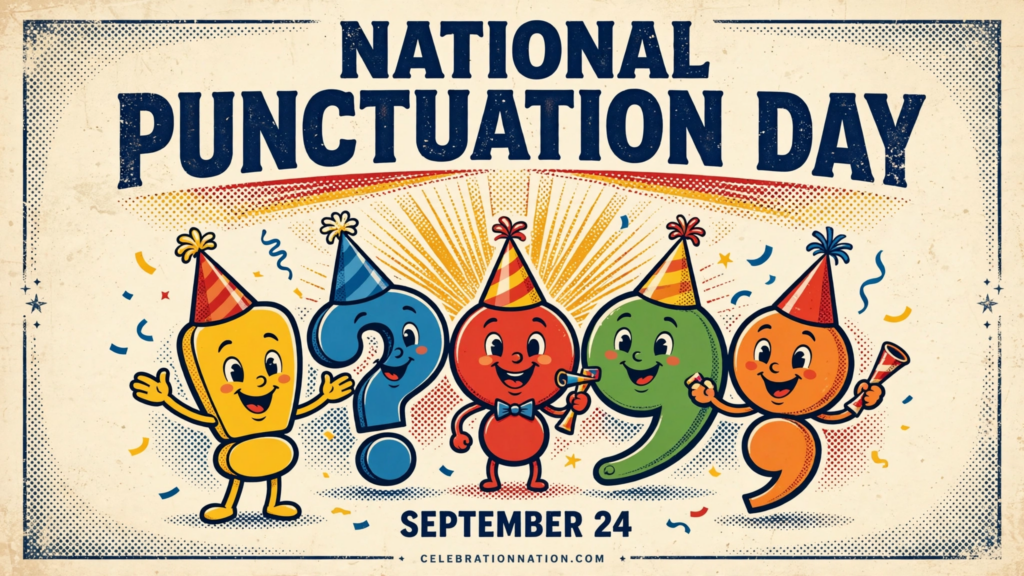
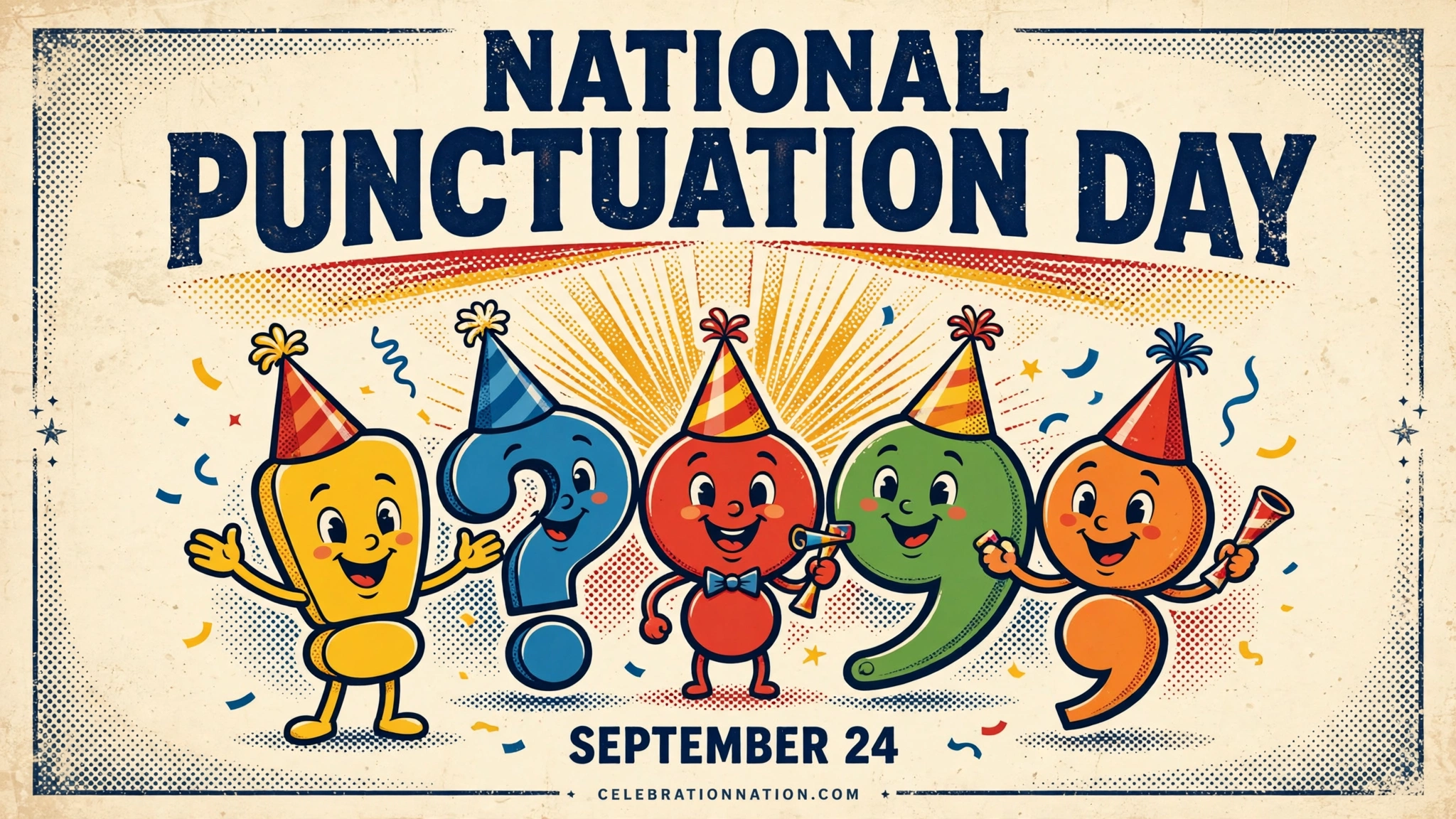
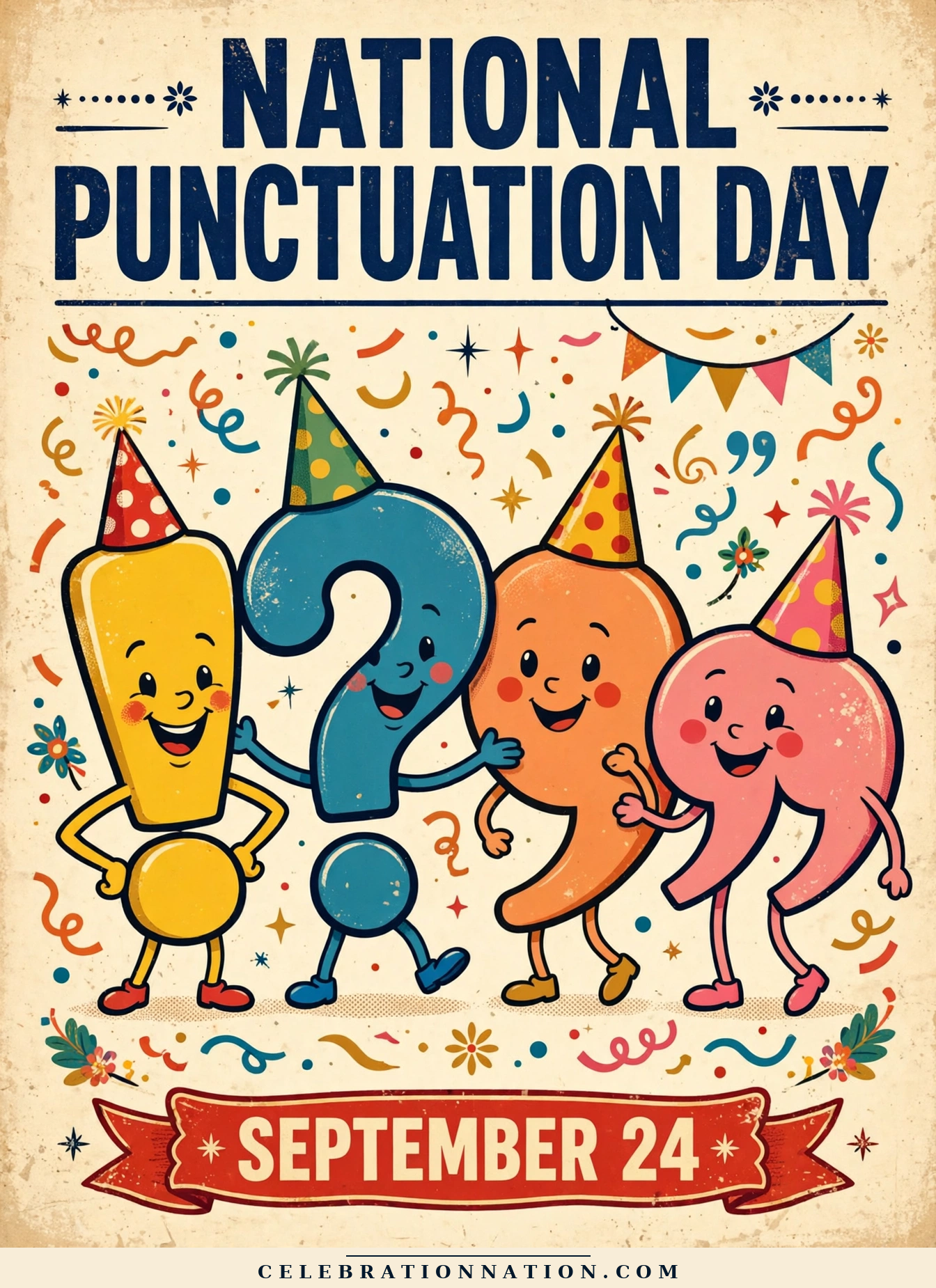
National Punctuation Day
Celebrate the vital role of punctuation in communication with a focus on clarity.
- Roots
- Founded in 2004 by Jeff Rubin
- Vibe
- Fun and educational
- Also on Sep 24
- Schwenkfelder Thanksgiving · World Maritime Day · Cherries Jubilee Day
- Hashtag
- #NationalPunctuationDay
3 ways to celebrate
Proofread something
Revisit an old letter or story and polish up its punctuation.
Play grammar games
Challenge friends to spot punctuation errors in funny sentences.
Fix the signs
Hunt for misplaced apostrophes on signs and menus around town.
Plan ahead
National Punctuation Day is observed on September 24 every year. Here is where it lands for the next ten years, handy for planners, marketers and party people.
Fast facts
The story
National Punctuation Day was founded in 2004 by Jeff Rubin, a former teacher and author who recognized the need for a day dedicated to the often-overlooked punctuation marks that shape our written language. This observance falls on September 24 each year, a date chosen for its simplicity and easy remembrance. The day aims to bring awareness to the correct usage of punctuation and its impact on communication. From commas and periods to semicolons and dashes, each mark serves a unique purpose in helping readers understand the intended message.
Read the full story
Punctuation is not just a set of arbitrary rules; it is a vital component of writing that enhances clarity and meaning. Misplaced commas can change the entire context of a sentence, leading to misunderstandings. For example, consider the difference between 'Let's eat, Grandma!' and 'Let's eat Grandma!', a simple comma can save lives. In an age of digital communication, where messages are often hastily typed, the importance of punctuation becomes even more pronounced. It can make the difference between a professional and a casual tone.
Celebrating National Punctuation Day can take many forms, from educational activities in schools to engaging discussions in workplaces. People are encouraged to share their favorite punctuation marks on social media, participate in writing challenges, and even organize trivia nights focused on punctuation rules. Such activities not only make learning about punctuation fun but also foster a community of writers who appreciate the nuances of language. Various resources, including books and online guides, offer valuable insights into the correct usage of punctuation in both creative and professional writing.
As we observe National Punctuation Day, let us take a moment to reflect on how these small symbols have a big impact on our communication. Whether you are a seasoned writer or just starting, understanding punctuation can enhance your writing skills and ensure your messages are conveyed accurately. So, take a break from your regular routine and embrace the art of punctuation. Celebrate by crafting sentences that are not only grammatically correct but also engaging and enjoyable to read.
Did you know?
The First Punctuation Marks
The first known punctuation marks were used by ancient Greeks.
Comma's Origin
The term 'comma' comes from the Greek word for 'a piece cut off'.
The Oxford Comma
The Oxford comma is often debated among writers.
Exclamation Points
Overusing exclamation points can diminish their impact.
Semicolon Usage
Semicolons connect closely related ideas.
Question Marks
Question marks originated from a Latin word meaning 'to inquire'.
Punctuation in Other Languages
Different languages have unique punctuation rules.
Around the world
Every culture celebrates a little differently.
- USUnited StatesNational Punctuation Day is widely celebrated across the U.S.
- GBUnited KingdomPunctuation usage is crucial in British English.
- CACanadaCanadians also appreciate clear writing.
- AUAustraliaPunctuation rules vary slightly in Australian English.
- INIndiaEnglish punctuation is essential in Indian education.
- ZASouth AfricaA multicultural perspective on punctuation usage.
Keep the party going
See the calendar
Celebrate every day, all year
Official gear from the people who track 1,700+ celebrations.
Browse the shop 2027 Wall Calendar, signed by Marlo AndersonSigned by the founder of National Day Calendar.
Never miss a reason to celebrate.
One quick morning email with today's celebrations, ideas and posters. Free, unsubscribe anytime.
🎉 You're on the list! Watch your inbox for The Daily Confetti.