


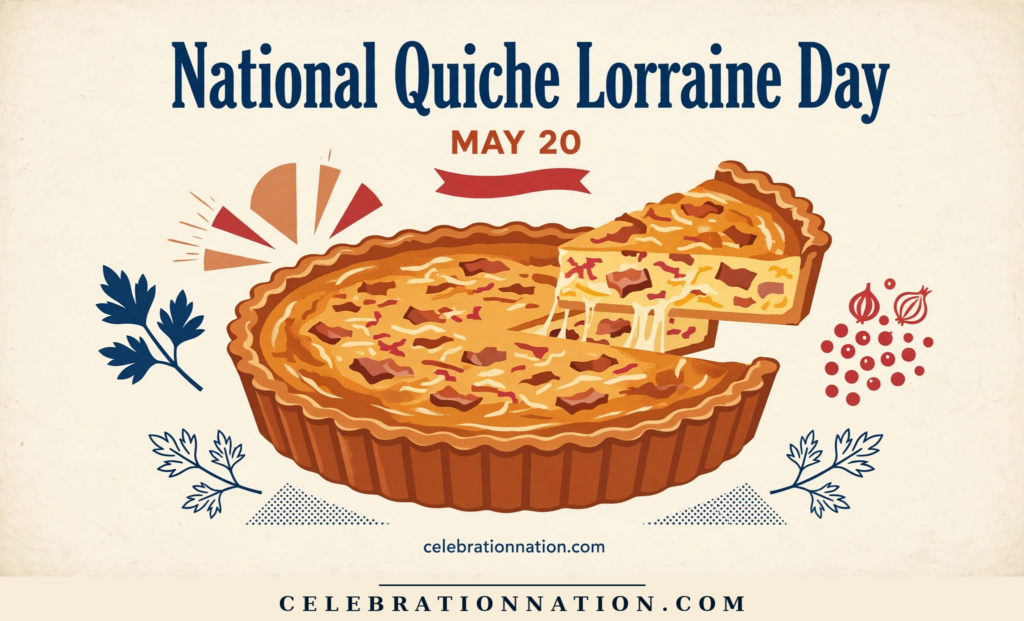
National Quiche Lorraine Day
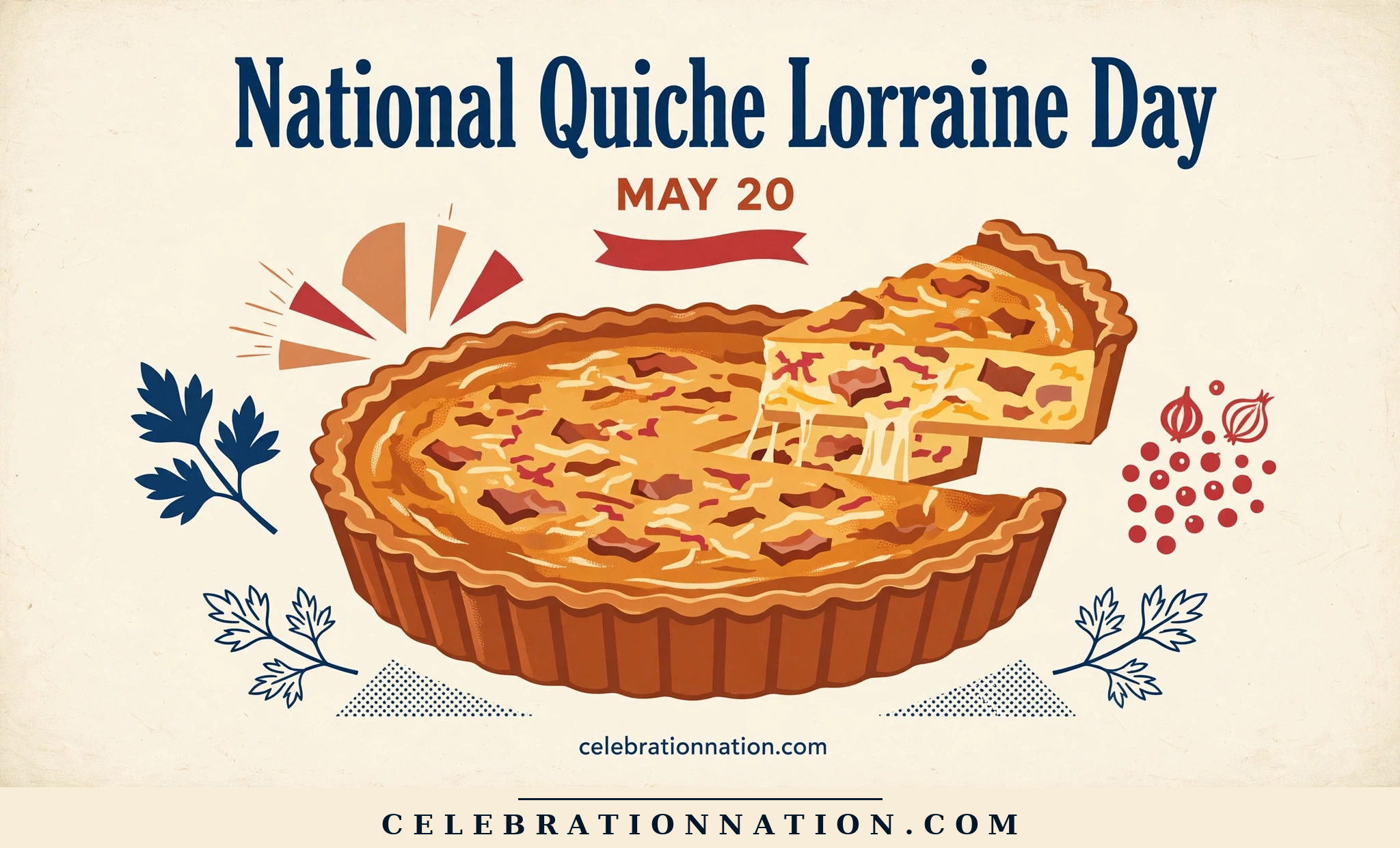
National Quiche Lorraine Day on May 20 honors the buttery, smoky, French-originated savory tart that Julia Child made American household vocabulary in the 1960s. Egg, cream, bacon, Gruyère, in a buttery pastry shell. A brunch-menu, quiche-for-lunch, church-potluck classic that has stayed in the American kitchen for 60 years.
- Roots
- Lorraine region, France
- Vibe
- French-Inflected Brunch
- Also on May 20
- World Bee Day · World Metrology Day · Rescue Dog Day
- Hashtag
- #NationalQuicheLorraineDay
Ways to celebrate
Bake, brunch, and enjoy:
- 🥧 Bake a scratch quiche. Buttery tart shell, blind-baked; egg-cream custard, bacon, Gruyère, bake 45 minutes at 350°F. Elegant brunch; simpler than you think.
- 🍳 Host a brunch. Quiche Lorraine + fruit salad + mimosas + good coffee = foolproof brunch for 4-8.
- 📚 Read Julia Child. 'Mastering the Art of French Cooking Volume 1' (1961) has the recipe that made quiche American. Still unsurpassed for technique.
- 🧀 Experiment with variations. Spinach (Florentine), mushroom, leek, broccoli-cheddar — but classic Lorraine first.
- 🇫🇷 Take it to the office. Makes an exceptional work lunch, served room-temp or cold.
Make it your kind of celebration
Family
Family brunch. Kids love whisking the eggs; the smell of bacon and cheese is universally appealing.
Kids
Let them help press the crust into the tart pan. Satisfying tactile work; produces a meaningful result.
Couples
Sunday brunch at home: quiche, fresh orange juice, strong coffee, the newspaper. Civilized perfection.
Office
Quiche for a team brunch or work lunch. Reheats cleanly; cuts elegantly; serves 8 from a single 9-inch pan.
School
Great technique lesson in home economics — pastry, custard, and blind-baking all in one recipe.
Community
Excellent church-supper, brunch-potluck, or bridal-shower contribution. Travels well; serves elegantly.
Just me
Bake one; eat from it all week. Slices reheat at 350°F for 10 minutes. One of the best meal-prep dishes in American cooking.
Plan ahead
National Quiche Lorraine Day is observed on May 20 every year. Here is where it lands for the next ten years, handy for planners, marketers and party people.
Fast facts
The story
Quiche comes from the German word 'kuchen' (cake), a reminder that the Lorraine region of France has been contested territory between France and Germany for centuries. Lorraine was part of the Holy Roman Empire into the 1700s, French from 1766 to 1871, German from 1871 to 1918, French again after World War I. Quiche Lorraine reflects this border history: a French name, a Germanic word-root, and a filling of eggs, cream, and bacon, all indistinguishable from the Elsass-Lothringen border cooking that predates modern national identities.
Read the full story
The traditional Lorraine filling is deliberately simple: eggs, heavy cream, smoked bacon (lardons), nutmeg, salt, pepper. No cheese in the strictest traditional version, though most French and American recipes now include Gruyère or Emmental. No vegetables, no onions (onions make it 'Alsacienne,' a sibling variation). The pastry is a simple pâte brisée, flour, butter, water, salt. What makes the dish elegant is proportion and technique, not ingredients.
Quiche Lorraine was not widely known in America before 1961. That year, Julia Child's 'Mastering the Art of French Cooking' (co-authored with Simone Beck and Louisette Bertholle) published the first English-language recipe widely available to American home cooks. Child's subsequent television show "The French Chef" (1963-1973) repeatedly featured quiche. By 1970, quiche was a standard American brunch-menu offering. By 1975, quiche was firmly established in American home cooking.
The 1980s put quiche through a pop-culture detour. Bruce Feirstein's 1982 satirical bestseller 'Real Men Don't Eat Quiche' made quiche an American cultural punchline, framed as emblematic of 'sensitive,' upper-middle-class, non-macho eating. The joke, of course, undermined itself: everyone who ate quiche knew it was delicious, regardless of gender politics. After a brief dip, quiche rebounded in the 1990s and has remained a bedrock American brunch and make-ahead meal ever since. It is, by any measure, one of Julia Child's most successful cultural exports.
Four details that separate bakery-quality from rubbery:
Six American quiche traditions worth knowing:
Did you know?
Quiche is officially NOT a pie.
In French culinary definitions, quiche (savory, open-faced, custard-based) is a 'tarte' (tart), not a pie. Pies in French tradition are always sweet, always double-crusted, and always called 'tarte aux fruits' or similar. An American linguistic quirk; French purists are particular about it.
Julia Child didn't invent quiche for America, Louisette Bertholle did.
Julia Child's collaborator on 'Mastering the Art of French Cooking,' Louisette Bertholle, was actually French (Child was American, Simone Beck was French). Bertholle wrote the first English-language quiche Lorraine recipe published in America, a 1961 authorial credit obscured by Child's later fame.
Quiche was recession-era comfort food.
During the 1970s stagflation, quiche became popular in America partly because it stretched expensive ingredients: 4 eggs + 1 cup cream + 4 oz bacon + 4 oz cheese feeds 6-8 people. An economical party food that looked elegant. The 1970s brunch boom has economic as well as cultural roots.
Ina Garten's quiche recipe is a #1 best-seller.
Ina Garten's 'Barefoot Contessa' (1999) includes a 'Leek and Mushroom Quiche' that has been, for 25 years, one of her most-reproduced recipes. Her books have sold over 14 million copies. A modern American quiche canon.
Keep the party going
See the calendar
Celebrate every day, all year
Official gear from the people who track 1,700+ celebrations.
Browse the shop 2027 National Day Wall CalendarGet the 2026 edition free. 1,700+ observances.
Never miss a reason to celebrate.
One quick morning email with today's celebrations, ideas and posters. Free, unsubscribe anytime.
🎉 You're on the list! Watch your inbox for The Daily Confetti.