






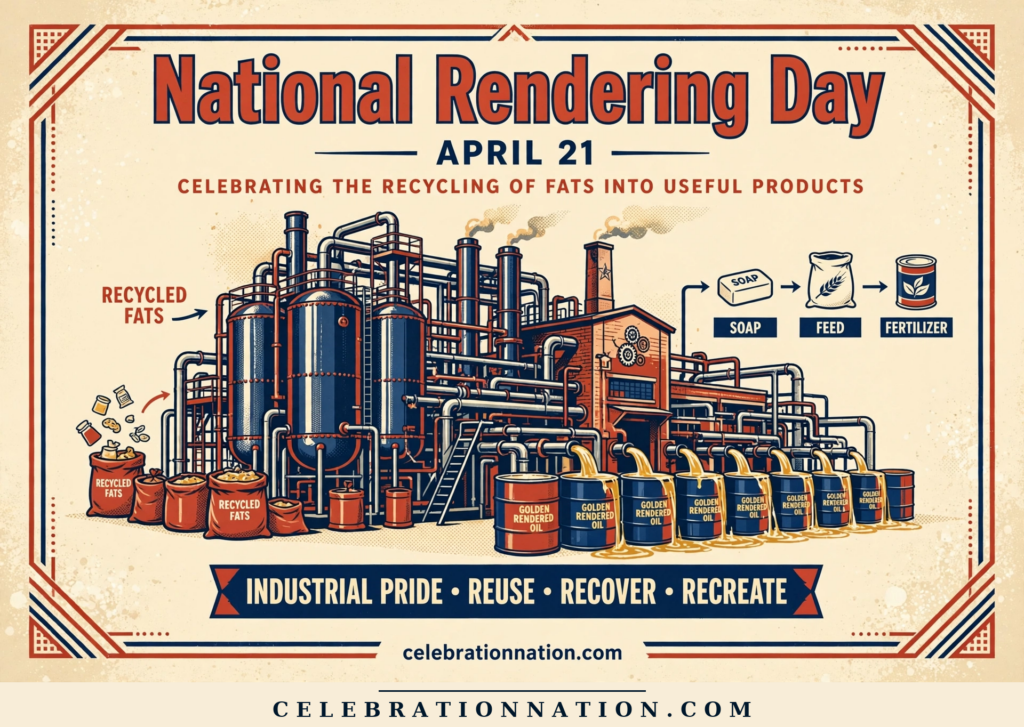
National Rendering Day
On National Rendering Day, we make a little room on the calendar for the thing that makes us who we are.
- Roots
- Created by the North American Renderers Association and National Day Calendar; first observed April 21, 2023.
- Vibe
- Community-focused and educational
- Also on Apr 21
- British National Tea Day · World Creativity and Innovation Day · Chocolate-Covered Cashews Day
- Hashtag
- #NationalRenderingDay
Ways to celebrate
Small, doable ways to celebrate National Rendering Day.
- Do one small thing that makes the day feel marked.
- Tell someone what you're celebrating and why.
- Share a post, a photo, or a memory connected to it.
- Make a tiny tradition — something you could do again next year.
- Let it be simple. Not every celebration has to be a production.
Make it your kind of celebration
Family
Do one small thing together that everyone will remember.
Kids
Turn it into a craft, a story, or a snack — meet them where they are.
Couples
Use the day as an excuse for a little intentional time together.
Office
Acknowledge the day in the team chat or at a stand-up. Small, sincere, fast.
School
Anchor a short lesson or activity around the day.
Community
Share, volunteer, or donate to make the day mean something locally.
Just me
Celebrate quietly and completely. One person can still mark a day.
Plan ahead
National Rendering Day is observed on April 21 every year. Here is where it lands for the next ten years, handy for planners, marketers and party people.
Fast facts
The story
Rendering plays a crucial role in the agricultural and food industries, transforming animal by-products into useful materials such as fats, proteins, and biofuels. This process not only supports the economy but also contributes to sustainable practices by minimizing waste. Established to raise awareness about these benefits, National Rendering Day is celebrated on April 21 each year, encouraging discussions on recycling and waste reduction.
Read the full story
The rendering industry has a deep-rooted history in the United States, with origins dating back to the early 1800s. Initially, rendering was a way to preserve meat, but it evolved into a sophisticated process that now plays a vital role in food safety and resource management. As food waste continues to be a global concern, the rendering industry provides a solution by repurposing what would otherwise be discarded.
Educational initiatives and community involvement are essential components of National Rendering Day. Schools and organizations are encouraged to engage in activities that promote an understanding of rendering's role in sustainability. Workshops, field trips, and community events help to highlight the importance of responsible waste management and eco-friendly practices, making it a day for both learning and celebration.
As we observe National Rendering Day, it is a reminder of the impact our choices have on the environment. By supporting the rendering industry and advocating for sustainable practices, we can contribute to a healthier planet. This day encourages everyone to reflect on their consumption habits and consider how they can support initiatives that prioritize waste reduction and recycling.
Did you know?
What is Rendering?
Rendering is the process of converting animal by-products into usable materials.
Historical Significance
The practice dates back to ancient civilizations for food preservation.
Environmental Impact
Rendering reduces landfill waste significantly.
By-Products Utilization
Rendered products are used in food, cosmetics, and biofuels.
Economic Contribution
The rendering industry generates billions in revenue annually.
Sustainability Champion
Rendering supports sustainable agriculture and resource management.
Community Engagement
National Rendering Day promotes awareness and education.
Around the world
Every culture celebrates a little differently.
- USNorth AmericaRendering is a major industry in the U.S., essential for waste reduction.
- BRSouth AmericaRendering practices are growing to address food waste.
- EUEuropeEuropean countries emphasize sustainable rendering methods.
- AUAustraliaAustralia's rendering industry supports local farmers.
- CNAsiaRendering practices are evolving in Asian markets.
- ZAAfricaRendering contributes to local economies and food safety.
Keep the party going
See the calendar



Celebrate every day, all year
Official gear from the people who track 1,700+ celebrations.
Browse the shop 2027 Wall + Desk Calendar BundleCelebrate every day at home and at work.
Never miss a reason to celebrate.
One quick morning email with today's celebrations, ideas and posters. Free, unsubscribe anytime.
🎉 You're on the list! Watch your inbox for The Daily Confetti.