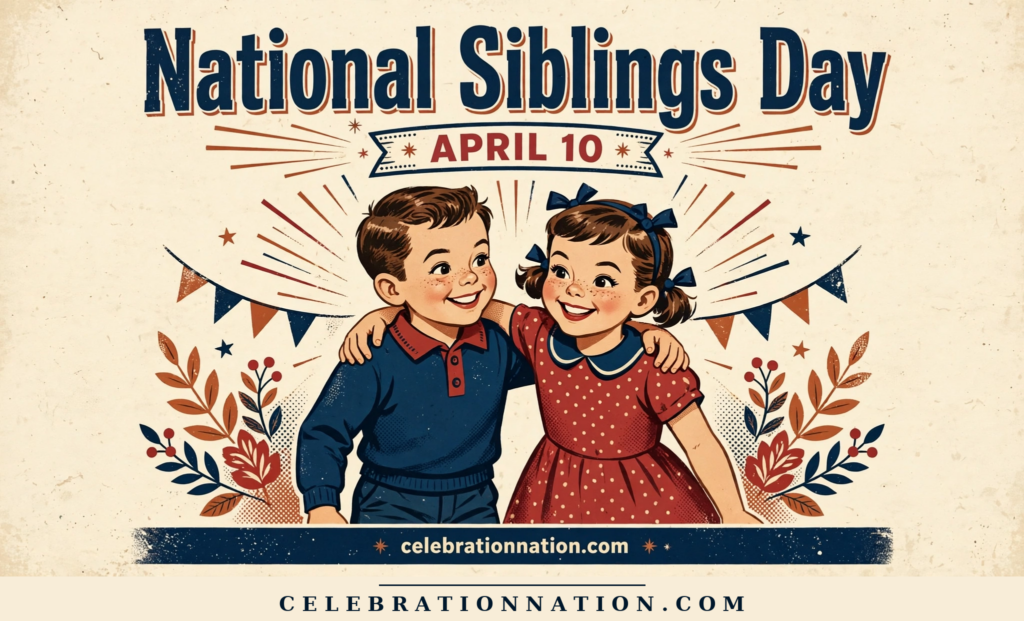
National Siblings Day
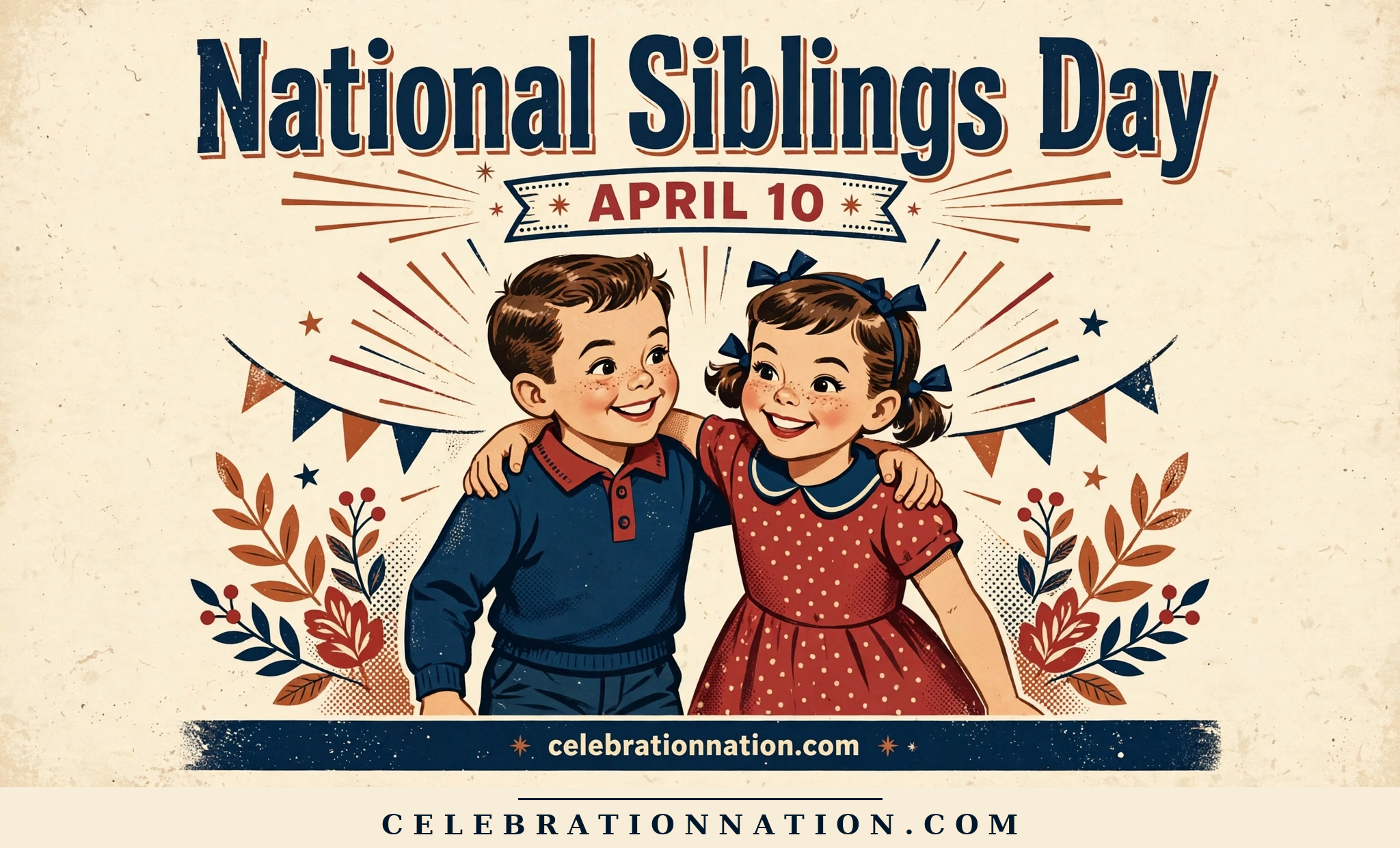
National Siblings Day on April 10 honors the most complicated, most formative relationships in most Americans' lives — brothers and sisters. Established in 1995 by Claudia Evart of Brooklyn, in memory of her siblings lost too early. A day for text messages, phone calls, old photographs, and the relationships that shape us longer than any other. Roughly 80% of Americans grow up with siblings.
- Vibe
- Connected & Formative
- Also on Apr 10
- World Homeopathy Day · International Safety Pin Day · Cinnamon Crescent Day
- Hashtag
- #NationalSiblingsDay
Ways to celebrate
Call, text, post, remember:
- 📞 Call your sibling. The simplest and most impactful gesture. Not a text — a real phone call. Even 10 minutes matters.
- 📸 Post an old photo. The 'throwback Thursday' energy of Siblings Day is real — dig out the childhood pic and post it.
- 💌 Write a letter. A real handwritten letter to a sibling. Specific memories, specific gratitude. Treasured; often kept for life.
- 🎁 Send a small gift. A bookstore gift card, a coffee subscription, something nostalgic. Small; meaningful.
- 🕯️ Remember lost siblings. For those who have lost brothers or sisters — this day is particularly for you. Light a candle; share a memory; feel the grief openly.
Make it your kind of celebration
Family
Family photo session. Parents, siblings, kids. A real annual tradition worth starting. Even a 5-minute phone shoot; add to the family archive.
Kids
Ask kids about their favorite sibling memory (or favorite sibling story, for adults with siblings). Great dinner-table conversation.
Couples
Partnered adults should coordinate: one writes a note to sibling; the other writes to in-laws' siblings. A quiet gift to each other's families.
Office
Low-key social moment — 'share a childhood-sibling story' round at a team meeting. Surprisingly bonding.
School
Family-tree or sibling-themed writing prompts. Many American elementary schools have annual Siblings Day activities.
Community
Community center families could organize a siblings photo booth or drop-in activity. Simple, meaningful.
Just me
Solo response: a real conversation with a sibling. Not social-media response; not a group text. Individual, meaningful.
Plan ahead
National Siblings Day is observed on April 10 every year. Here is where it lands for the next ten years, handy for planners, marketers and party people.
Fast facts
The story
Sibling relationships are unique. They typically begin earlier than any other relationship (childhood), last longer (often 70+ years), and survive changes that many other relationships don't (parents' deaths, marriages, divorces, relocations). In most American families, siblings know each other longer than they know their parents or their spouses. Research consistently shows that close sibling relationships in adulthood correlate with life satisfaction, mental health, and longevity.
Read the full story
National Siblings Day was established in 1995 by Claudia Evart, a Brooklyn-based family-law attorney. Evart had lost both of her siblings, her older brother Alan (d. 1973) and younger sister Lisette (d. 1986), at young ages. The loss was formative; the day was her way of making meaning from it. She founded the Siblings Day Foundation, a nonprofit that lobbied successfully for state governors to proclaim April 10 annually. As of 2026, all 50 US states have proclaimed National Siblings Day at least once; many make it an annual proclamation. Evart herself received the United Nations' World of Difference award.
American siblinghood has shifted demographically over time. The average American family in 1950 had 3.5 children; today, 1.9. Only-child households have grown from 10% in 1970 to ~25% today. Yet the proportion of Americans who have at least one sibling remains around 80%, because families with two or more children still dominate the overall population. Siblings now typically live farther apart than in previous generations, averaging ~250 miles apart in adulthood making intentional connection more important than ever.
The day has become a genuinely important American digital observance, particularly on Instagram and Facebook, where #NationalSiblingsDay is one of the top trending hashtags of April 10 each year. Millions of Americans post childhood photos with their siblings. The simple act of reaching out connects millions. For those who have lost siblings, the day is particularly tender, a space to remember openly. For those with difficult sibling relationships, it offers a gentle invitation to reach out. Claudia Evart's idea, born of grief, has become a modest but meaningful American observance.
The relationship takes many forms:
Six famous American sibling relationships:
Did you know?
Claudia Evart is still active.
Claudia Evart, now 75+ years old, still practicing law in Brooklyn, continues to run the Siblings Day Foundation. She has lobbied governors and presidents for annual proclamations. One of the most persistent American civic-day activists.
The day is NOT a federal holiday.
Despite 50-state proclamations and 30 years of observance, National Siblings Day has never been federally designated. No US President has signed an annual proclamation. A common pattern, many widely-observed days aren't federal holidays.
Birth order is less influential than we think.
Contemporary sibling research (Judith Rich Harris, 1998, and follow-up studies) has largely debunked the 'birth order determines personality' theory. Real determinants are genes, family environment, individual temperament. Birth-order effects, if they exist, are small.
Lost siblings are an underdiscussed grief.
Sibling death is less formally recognized than parent or spouse death in American grief literature, but is often one of the most profound losses. Claudia Evart's founding of Siblings Day was partly to give public voice to this private grief. A real contribution.
Keep the party going
See the calendar
Celebrate every day, all year
Official gear from the people who track 1,700+ celebrations.
Browse the shop 2027 Wall Calendar, signed by Marlo AndersonSigned by the founder of National Day Calendar.
Never miss a reason to celebrate.
One quick morning email with today's celebrations, ideas and posters. Free, unsubscribe anytime.
🎉 You're on the list! Watch your inbox for The Daily Confetti.