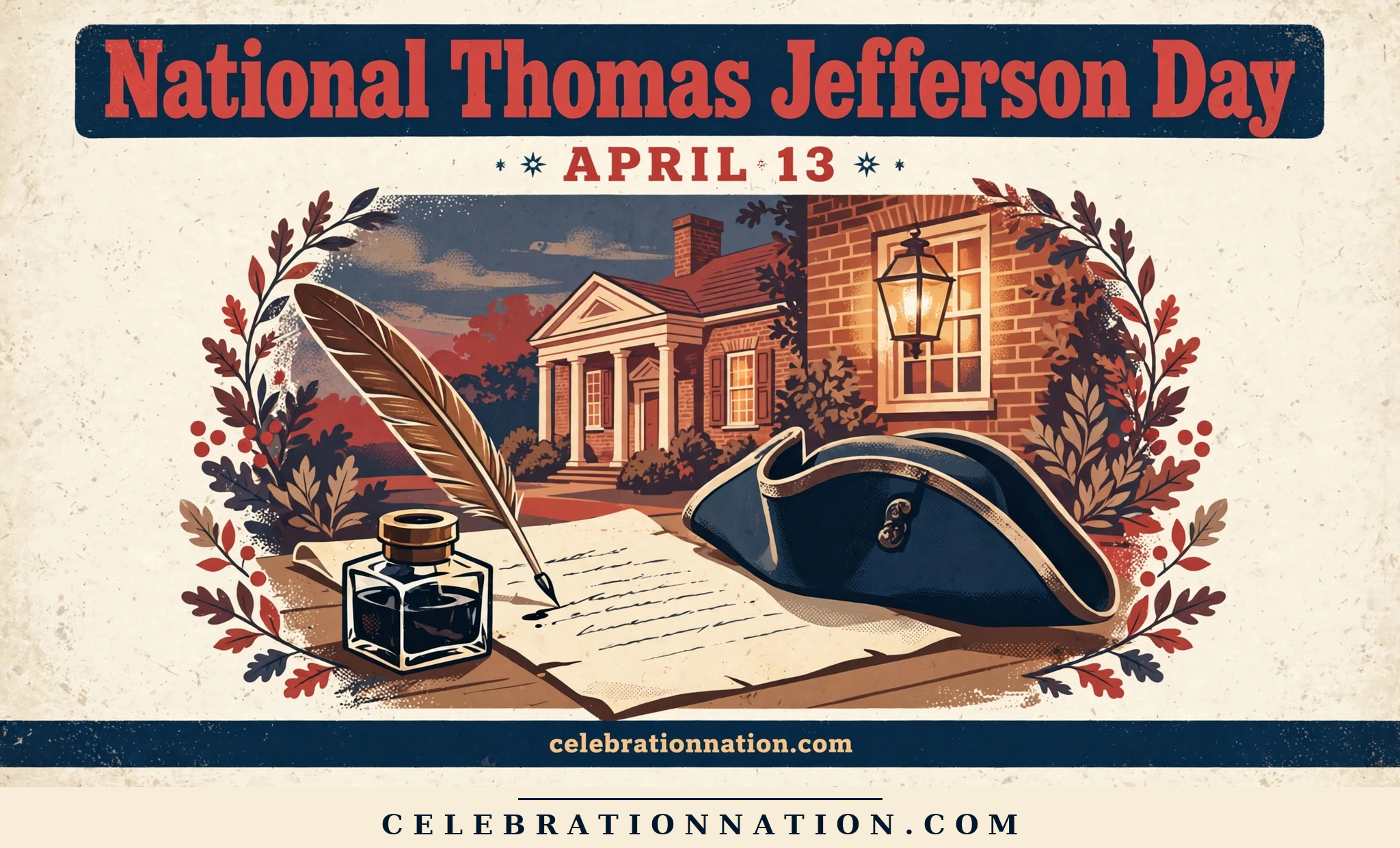
National Thomas Jefferson Day
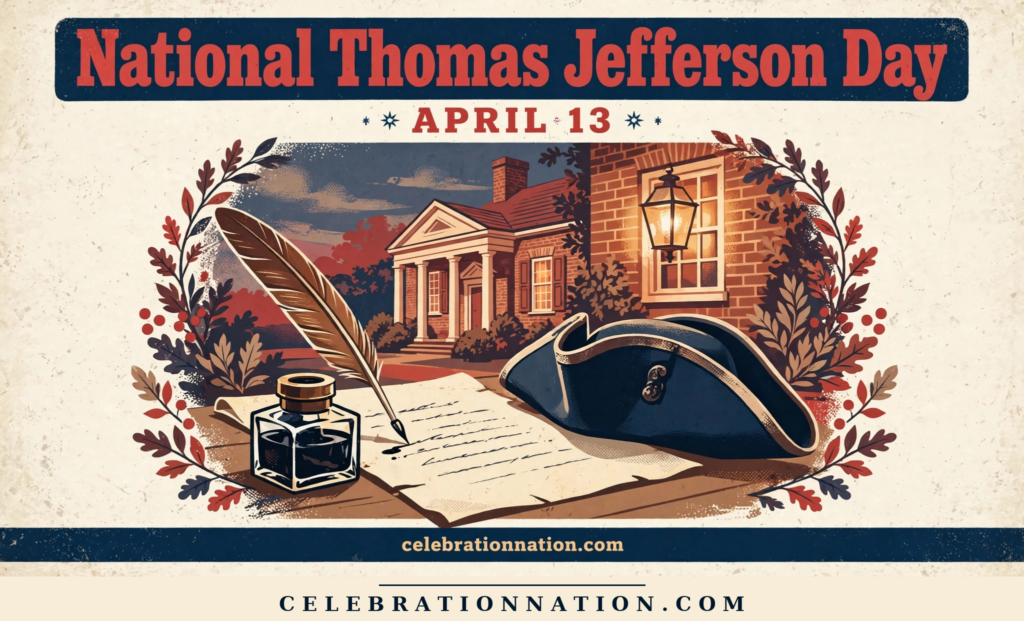
National Thomas Jefferson Day on April 13 marks the birthday of America's third president — founding father, author of the Declaration of Independence, architect, inventor, farmer, and slaveholder. A man of extraordinary contradictions and towering achievements, Jefferson remains one of the most consequential figures in American history. Born 1743; still argued about 283 years later.
- Vibe
- Complex & Consequential
- Also on Apr 13
- International Fnd Awareness Day · World Awareness Sarcoidosis Day · Borinqueneers Day
- Hashtag
- #NationalThomasJeffersonDay
Ways to celebrate
Honor a complicated man — and a foundational text:
- 📜 Re-read the Declaration of Independence. It's short. 1,320 words. Takes 7 minutes. Few political documents improve more on a re-reading.
- 🏛️ Visit Monticello. Jefferson's home in Charlottesville, VA is one of the great American historical sites. The Sally Hemings tour is essential.
- 📖 Read a real biography. Jon Meacham's 'Thomas Jefferson: The Art of Power' is the best modern one. Annette Gordon-Reed's 'The Hemingses of Monticello' is the essential counterpoint.
- 🏛️ Visit a public library. Jefferson founded the University of Virginia, championed public education, sold his personal library to Congress (became the Library of Congress). Libraries are Jefferson's most living legacy.
- 🍷 Try a Virginia wine. Jefferson tried for 30 years to grow European grapes at Monticello. Failed every time. Modern Virginia viticulture finally cracked it — a Monticello-area wine honors the obsession.
Make it your kind of celebration
Family
Read the Declaration together. Discuss what it promised and what still isn't delivered. 4th grade and up can handle the conversation.
Kids
'Who Was Thomas Jefferson?' (Scholastic biography) is a great 3rd-grade introduction. Pair with Monticello's kid-friendly website.
Couples
Monticello weekend trip — Charlottesville is one of the most beautiful small cities in America. Wine country, great food, the Lawn at UVA.
Office
Jefferson quotes make for surprisingly non-cheesy office morale. 'The most valuable of all talents is that of never using two words when one will do.' — relevant every day.
School
Essential American history. Teach Jefferson's brilliance AND his slaveholding honestly. Modern pedagogy requires both.
Community
Local historical society talks around Jefferson Day. Most have something programmed.
Just me
The Declaration, a coffee, 10 quiet minutes. It's a more radical document than most Americans remember.
Plan ahead
National Thomas Jefferson Day is observed on April 13 every year. Here is where it lands for the next ten years, handy for planners, marketers and party people.
Fast facts
The story
Thomas Jefferson was born on April 13, 1743, in Shadwell, Virginia. Son of a planter; grew up among enslaved people whose labor made his education possible. Entered William & Mary at 16. Fluent in Latin, Greek, French, Italian, Spanish. Trained as a lawyer.
Read the full story
At 33, in summer 1776, he drafted the Declaration of Independence, 17 days of writing in a Philadelphia rooming house. The document borrowed from John Locke, from George Mason's Virginia Declaration of Rights, and from the English political tradition. But the synthesis, 'We hold these truths to be self-evident, that all men are created equal', was Jefferson's. It remains the most influential American sentence ever written.
After the Revolution, Jefferson served as governor of Virginia, ambassador to France, Washington's Secretary of State, Adams' Vice President, and finally the third President (1801-1809). The Louisiana Purchase in 1803 doubled the country's size; the Lewis & Clark expedition mapped it. He founded the University of Virginia, designed the buildings himself, and pushed public education long before it was a mainstream American cause.
Jefferson was also, throughout all of this, a slaveholder. He enslaved 607 people across his lifetime at Monticello. He had a decades-long relationship with Sally Hemings, a woman he enslaved, that produced six children. He wrote about the evils of slavery while living by its profits. For two centuries this was minimized; over the last thirty years, scholars and institutions (including Monticello itself) have reckoned with it fully. The result is a more honest, and more American, picture. Jefferson is the country's great paradox. He remains essential reading.
Four careers Jefferson held, any one of which would have made a normal man famous:
Six pilgrimage sites for the Jefferson-curious:
Did you know?
Jefferson died on July 4, 1826.
The 50th anniversary of the Declaration of Independence. John Adams died the same day, a few hours later. Adams's last words were reportedly 'Thomas Jefferson survives.' (He did not.)
Jefferson wrote his own epitaph.
It lists three achievements: author of the Declaration of Independence, author of the Virginia Statute for Religious Freedom, and founder of the University of Virginia. Does not mention being president.
Jefferson had 11 grandchildren.
Only one, Thomas Jefferson Randolph, attended his funeral, since the others were either too young or too distant. The family was devastated by Jefferson's debt (~$3M in today's dollars) which took a decade to resolve.
Jefferson spoke 5 languages.
Latin, Greek, French, Italian, and Spanish. He learned Spanish on the boat to France in 1784, reading Don Quixote with a Spanish dictionary. He called himself 'a fanatic for languages.'
Keep the party going
See the calendar
Celebrate every day, all year
Official gear from the people who track 1,700+ celebrations.
Browse the shop 2027 Wall + Desk Calendar BundleCelebrate every day at home and at work.
Never miss a reason to celebrate.
One quick morning email with today's celebrations, ideas and posters. Free, unsubscribe anytime.
🎉 You're on the list! Watch your inbox for The Daily Confetti.