









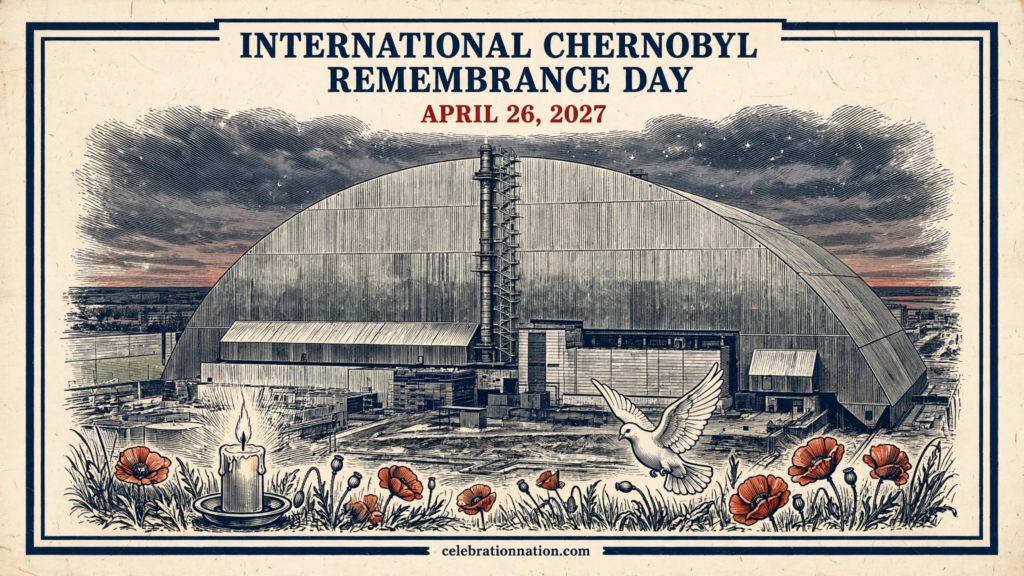
International Chernobyl Remembrance Day
Every year on April 26, the world pauses to remember the night the sky caught fire. On this date in 1986, reactor 4 at the Chernobyl Nuclear Power Plant exploded in the worst nuclear accident in history. We remember the lives lost, the communities uprooted, and the long shadow the disaster still casts across generations. All are welcome to remember, in whatever quiet way feels right.
- Also on Apr 26
- World Intellectual Property Day · Audubon Day · Dissertation Day
- Hashtag
- #InternationalChernobylRemembranceDay
INTERNATIONAL CHERNOBYL REMEMBRANCE DAY
Every year on April 26, the world pauses to remember the night the sky caught fire. On this date in 1986, reactor 4 at the Chernobyl Nuclear Power Plant exploded in the worst nuclear accident in history. We remember the lives lost, the communities uprooted, and the long shadow the disaster still casts across generations. All are welcome to remember, in whatever quiet way feels right.
In the early hours of April 26, 1986, a routine safety test at the Chernobyl Nuclear Power Plant near Pripyat, then part of the Soviet Union and now in Ukraine, went catastrophically wrong. An explosion and fire tore through reactor unit 4, releasing unprecedented levels of radioactive material into the atmosphere. Roughly 49,000 residents of Pripyat were evacuated within days, leaving behind a city frozen in time. The contamination spread across Ukraine, Belarus, Russia, and much of Europe, carried on winds that respected no borders. The explosion released vast quantities of radioactive isotopes, including iodine-131, cesium-137, and strontium-90, and its force spread contamination across large parts of what are now Belarus, Ukraine, and Russia. The disaster unfolded during what was meant to be a brief safety test of the plant’s electrical equipment, a detail that makes its consequences feel all the more staggering.
The human cost is difficult to comprehend. Thirty-one people died in the immediate aftermath, while some 600,000 “liquidators”, the firefighters and cleanup workers who contained the disaster, were exposed to high doses of radiation. About 8.4 million people across Belarus, Russia, and Ukraine were exposed, and nearly 404,000 were resettled away from contaminated land. In the years that followed, doctors recorded a sharp rise in thyroid cancer among children exposed to radioactive iodine. A 30-kilometer exclusion zone still rings the plant, and isotopes like cesium-137 and strontium-90 will linger in the soil for decades. Agricultural areas covering nearly 52,000 square kilometers were contaminated with cesium-137 and strontium-90, isotopes with 30-year and 28-year half-lives. Because radioactive decay runs on an exponential scale, scientists note it can take many decades, even centuries, for such material to become fully inert. In all, about 155,000 square kilometers of territory were contaminated. Nearly 404,000 people were resettled, yet millions continued to live in areas where continued residual exposure created a range of adverse health effects. The United Nations has underscored the need to strengthen international cooperation to study, mitigate, and minimize the consequences of the disaster.
On December 8, 2016, the United Nations General Assembly adopted resolution A/RES/71/125, designating April 26 as International Chernobyl Disaster Remembrance Day. First observed in 2016 on the 30th anniversary of the disaster, the day recognizes what the Assembly called the “persistent serious long-term consequences” of Chernobyl and the continuing needs of affected communities, inviting member states, UN agencies, and civil society to observe it. The UN had already launched the International Chernobyl Research and Information Network in 2009 to support recovery, and advocates like Adi Roche, founder of Chernobyl Children International, have carried the stories of survivors to the world stage. In 2027, the world marks 41 years since the disaster: a solemn milestone, and a reminder that remembrance is a form of responsibility. The day is a global observance rather than a public holiday, marked by memorial events, educational programs, and quiet acts of remembrance around the world. It also renews a broader call: to raise awareness of the disaster’s consequences and of the risks of nuclear energy itself. In a speech to the General Assembly, Adi Roche, founder of the nonprofit Chernobyl Children International, called for renewed efforts to alleviate the suffering of people in the affected lands.
THE STORY BEHIND INTERNATIONAL CHERNOBYL REMEMBRANCE DAY
🕯 April 26, 1986
What was meant to be a brief safety test became the worst nuclear accident the world has ever seen. In the predawn hours, a power surge ripped through reactor unit 4 at Chernobyl, and the explosion that followed scattered dangerous radionuclides across the region. Within days, the entire city of Pripyat, home to roughly 49,000 people, stood empty. The date of the disaster became the date of remembrance. Nearly 520 dangerous radionuclides were released into the atmosphere, a scale of contamination the world had never confronted.
🕊 The Human Cost
Behind the statistics are people. Thirty-one died in the immediate crisis; 600,000 liquidators risked their health to contain it; 8.4 million were exposed across three countries; and nearly 404,000 left their homes, many forever. Children exposed to radioactive iodine developed thyroid cancer at alarming rates. The 30-kilometer exclusion zone remains, a quiet monument to what was lost. Millions more continued to live where residual exposure created a range of adverse health effects, a burden carried quietly for decades.
🌎 The World Responds
Three decades after the explosion, the United Nations acted. On December 8, 2016, the General Assembly designated April 26 as International Chernobyl Disaster Remembrance Day, acknowledging the disaster’s persistent long-term consequences and the ongoing needs of affected communities. The resolution invites every member state, UN agency, and civil society group to observe the day, and the UN’s Chernobyl research network, launched in 2009, continues to support recovery in the region. The Assembly’s language was deliberate: three decades on, it said, the serious long-term consequences persist, and the affected communities still have continuing needs.
❤ Why We Still Remember
Remembrance is not only about the past. Organizations like Chernobyl Children International, founded by Adi Roche, still aid families living with the disaster’s health effects, and each April 26 renews the call for nuclear safety worldwide. The affected communities of Belarus, Ukraine, and beyond have shown extraordinary resilience, rebuilding lives on land that will carry the accident’s mark for generations. To remember Chernobyl is to honor them, and to insist that such a disaster never happens again. Their resilience, rebuilding homes and lives in the disaster’s long shadow, is itself something worth honoring.
WAYS TO CELEBRATE
🕯 Pause and Remember
Observe a quiet moment on April 26 for the victims, the liquidators, and the hundreds of thousands who were displaced. Lighting a candle is a simple, dignified way to mark the day and keep their memory alive. If you light a candle, consider sharing why; remembrance grows stronger when its reasons are spoken aloud.
📖 Learn the History
Read firsthand accounts of the disaster and its aftermath, or visit a museum exhibit devoted to it. Understanding exactly what happened at Chernobyl, and why, is how the world keeps it from happening again. Survivor testimony, in particular, carries a weight no textbook can match.
🤝 Support Those Still Affected
Donate to a charity that aids Chernobyl-affected families, such as Chernobyl Children International, or share verified educational resources about the disaster. Four decades on, the affected communities still carry the consequences, and they should not carry them alone. Awareness is itself a form of aid: the less the world forgets, the more support keeps flowing.
Remember International Chernobyl Remembrance Day
Tell someone what happened there, and why it still matters. On April 26, we remember. We honor the 31 lives lost in those first terrible days, the liquidators who ran toward danger, and every family still living with what followed. May their memory guide us toward a safer world.
Plan ahead
International Chernobyl Remembrance Day is observed on April 26 every year. Here is where it lands for the next ten years, handy for planners, marketers and party people.
Keep the party going
See the calendar



Celebrate every day, all year
Official gear from the people who track 1,700+ celebrations.
Browse the shop 2027 National Day Desk CalendarA new celebration every morning. Daily tear-off.
Never miss a reason to celebrate.
One quick morning email with today's celebrations, ideas and posters. Free, unsubscribe anytime.
🎉 You're on the list! Watch your inbox for The Daily Confetti.