







Solar Eclipse Day
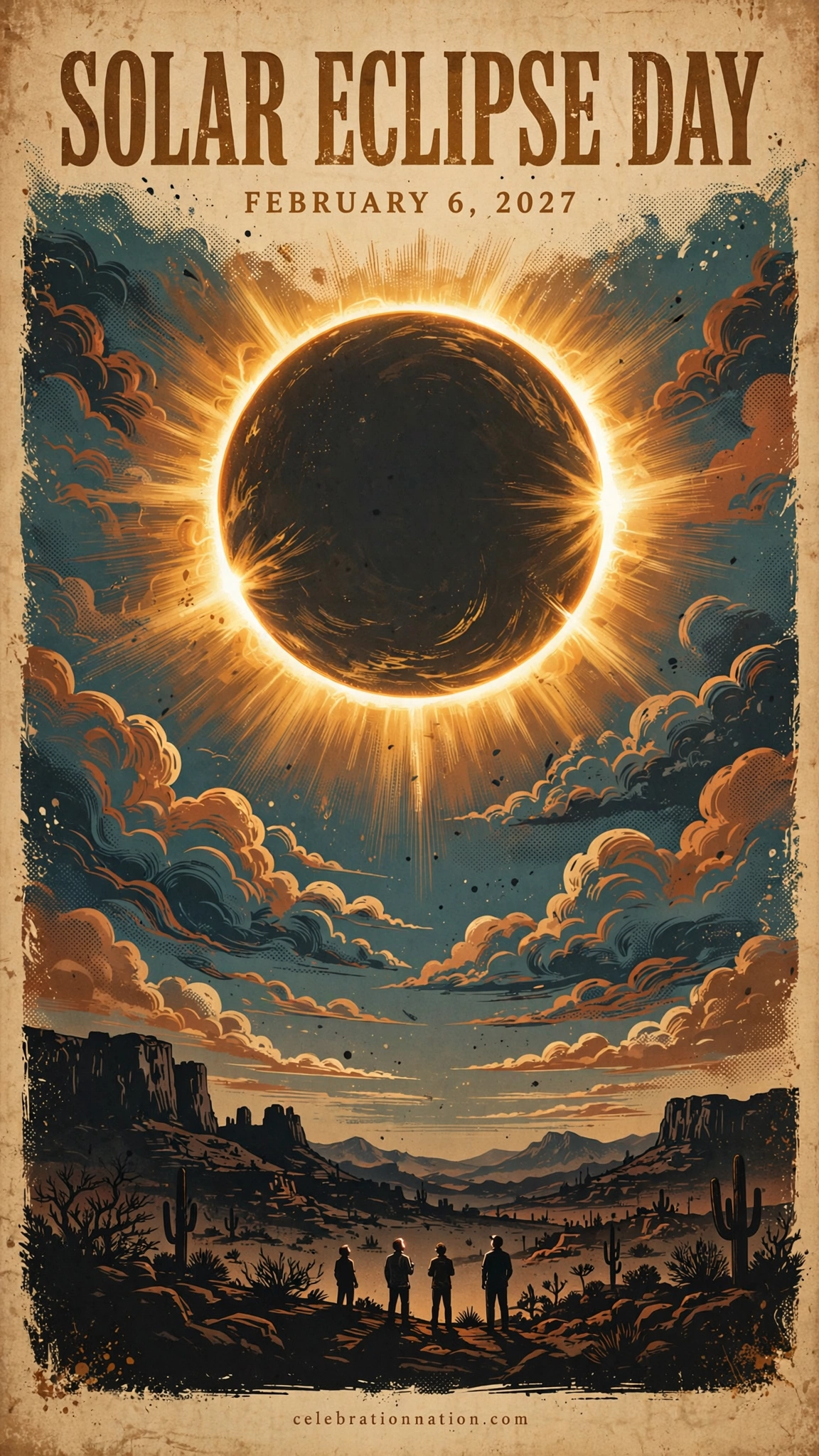
This year on February 6, the Moon slides in front of the Sun and leaves a blazing ring of sunlight around its silhouette, an annular eclipse known as the ring of fire. The path crosses southern South America and West Africa, where the ring shines for up to 7 minutes and 51 seconds.
- Roots
- An annular eclipse happens when the Moon is near apogee, its farthest point from Earth, so it appears slightly smaller than the Sun and cannot cover it completely.
- Also on Feb 6
- World Pisco Sour Day
- Hashtag
- #SolarEclipseDay
3 ways to celebrate
Wear Certified Eclipse Glasses
An annular eclipse is never safe to watch with the naked eye, because the Sun is never fully covered. Use certified eclipse glasses for the entire event, even during the ring phase.
Follow the Ring's Journey
The ring of fire crosses Chile and Argentina, clips Uruguay and Brazil, then reaches West Africa near sunset over cities including Abidjan, Accra, and Lagos. Follow its journey across the map as the day unfolds.
Catch the Partial Show
A partial eclipse will be visible across much of South America, parts of Antarctica, and much of the western half of Africa. If you are in the partial zone, the eclipse glasses rule still applies from start to finish.
Plan ahead
Solar Eclipse Day is observed on February 6 every year. Here is where it lands for the next ten years, handy for planners, marketers and party people.
Fast facts
The story
This eclipse is annular, not total. The Moon passes a few days past apogee, its farthest point from Earth, so it appears slightly smaller than the Sun and leaves a bright ring of sunlight around its silhouette. At greatest eclipse the Moon covers about 93 percent of the Sun's diameter, and the eclipse belongs to Saros series 131.
Read the full story
The path of annularity crosses southern South America first, passing through Chile, including Castro and the island of Melinka, and Argentina, including Viedma. It then clips Uruguay at Punta del Este and Brazil before crossing the South Atlantic, where greatest eclipse occurs at 16:00:48 UTC and the ring lasts up to 7 minutes 51 seconds.
The ring of fire then reaches West Africa near sunset, passing over the Ivory Coast at Abidjan, southern Ghana at Accra, southern Togo at Lome, southern Benin, and southwestern Nigeria at Lagos. A partial eclipse will be visible across much of South America, parts of Antarctica, and much of the western half of Africa, while North America, Europe, and Asia see nothing of this eclipse.
One safety rule has no exceptions: an annular eclipse is never safe to watch with the naked eye, because the Sun is never fully covered and the sky does not go dark. Certified eclipse glasses are required for the entire event, even during the ring phase.
Keep the party going
See the calendar




Celebrate every day, all year
Official gear from the people who track 1,700+ celebrations.
Browse the shop 2027 National Day Wall CalendarGet the 2026 edition free. 1,700+ observances.
Never miss a reason to celebrate.
One quick morning email with today's celebrations, ideas and posters. Free, unsubscribe anytime.
🎉 You're on the list! Watch your inbox for The Daily Confetti.