






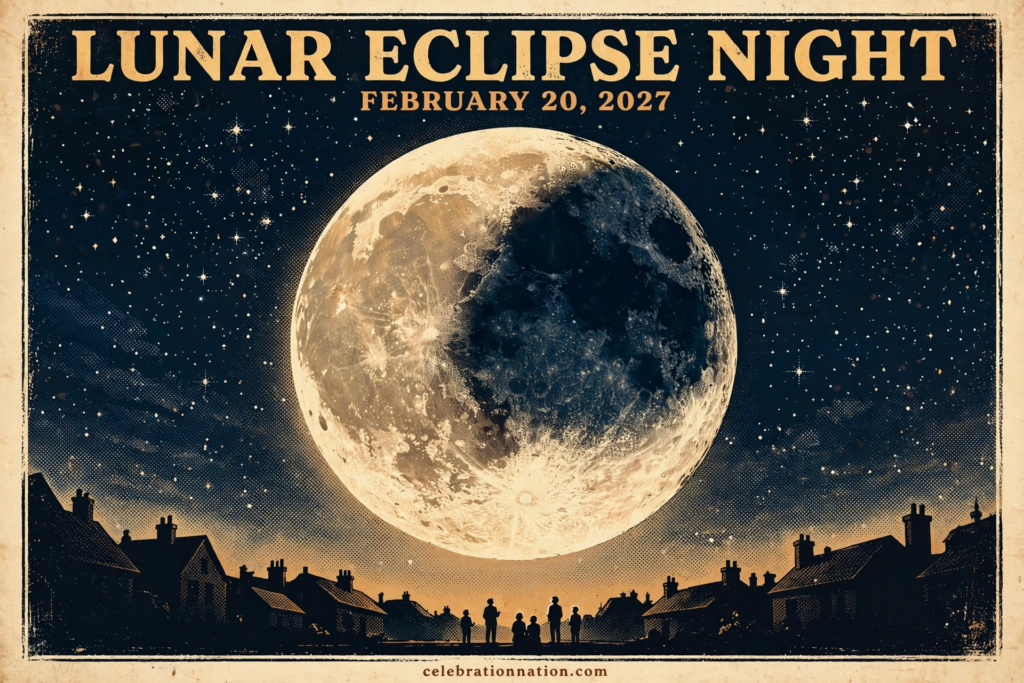
Lunar Eclipse Night
This year on February 20, the full Snow Moon drifts through the faint outer edge of Earth's shadow in a penumbral lunar eclipse. There is no dramatic red Moon this time, just a gentle shading across the lunar face that rewards a patient look.
- Roots
- A penumbral eclipse happens when the Moon passes only through Earth's faint outer shadow, the penumbra, and misses the dark inner umbra entirely.
- Also on Feb 20
- World Pangolin Day
- Hashtag
- #LunarEclipseNight
3 ways to celebrate
Look East at Moonrise
From the Central United States the Moon rises on February 20 already in eclipse, with the last traces of shading still on its face. Head out at moonrise and look east as it climbs.
Photograph the Difference
The shading is subtle, and a photo taken before and during the eclipse shows the difference best. Photograph the Moon early, then again an hour later, and compare the two.
Use Binoculars
A lunar eclipse is completely safe to watch with the naked eye, binoculars, or a telescope, no glasses needed. Binoculars make the gentle shading easier to spot.
Plan ahead
Lunar Eclipse Night is observed on February 20 every year. Here is where it lands for the next ten years, handy for planners, marketers and party people.
Fast facts
The story
Not every eclipse is a spectacle, and this one is honest about it. On February 20, 2027 the Moon passes only through Earth's faint outer shadow, the penumbra, and misses the dark inner umbra entirely; its umbral magnitude is negative, minus 0.0549. The result is a subtle shading across the Moon rather than a dark bite or a red blood Moon, with about 93 percent of the Moon's diameter inside the penumbra at greatest eclipse.
Read the full story
The eclipse runs about four hours, from 21:12 UTC on February 20 to 01:13 UTC on February 21, with greatest eclipse at 23:12:51 UTC, 5:12 pm Central Time. It falls on the February full Moon, the Snow Moon, and it comes about a day and a half after perigee, the Moon's closest approach to Earth, so the full Moon appears slightly larger than average.
The eclipse will be completely visible over Africa, Europe, and west, central, and south Asia, seen rising over North and South America, and setting over east Asia and western Australia. From the Central United States, the Moon rises on February 20 already in eclipse, and only the last traces of shading remain as it climbs, so the strongest views belong to the eastern side of the Atlantic.
This gentle event has been a long time coming. There were no lunar eclipses left in 2026 after its two events, a total eclipse on March 3 and a deep partial eclipse on August 28, which is why the next one lands here, on a winter night in February 2027.
Keep the party going
See the calendar



Celebrate every day, all year
Official gear from the people who track 1,700+ celebrations.
Browse the shop 2027 National Day Wall CalendarGet the 2026 edition free. 1,700+ observances.
Never miss a reason to celebrate.
One quick morning email with today's celebrations, ideas and posters. Free, unsubscribe anytime.
🎉 You're on the list! Watch your inbox for The Daily Confetti.