

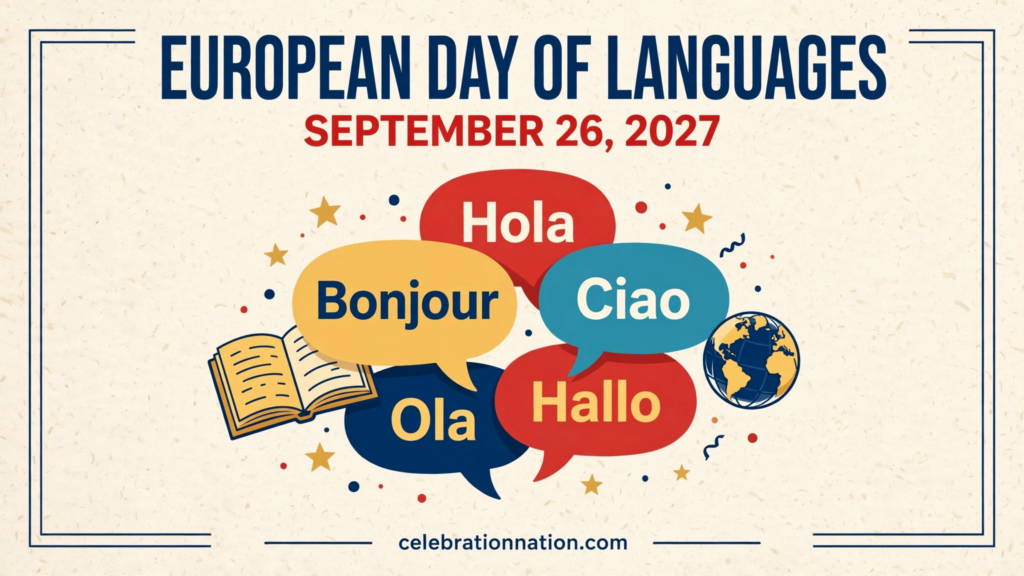
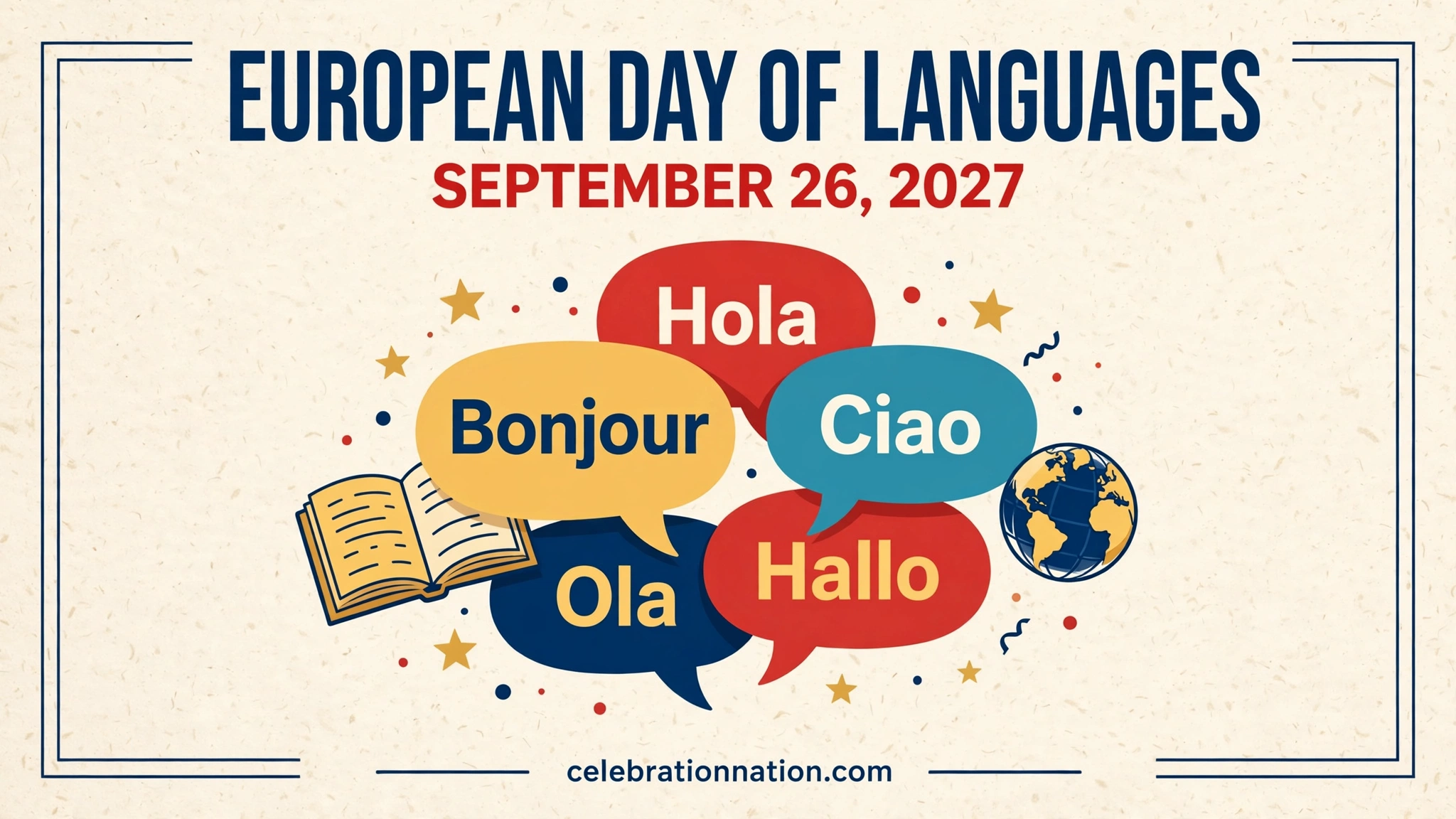
European Day of Languages
Every year on September 26, Europe turns up the volume on more than 225 indigenous languages, plus the immigrant tongues, regional languages, and signed languages that make the continent sing. The European Day of Languages celebrates linguistic diversity, encourages everyone to try a new language, and honors the plurilingual citizens who carry Europe's many voices. In 2027 the day falls on a Sunday, September 26. It is a joyful, curious observance, and its only requirement is an open ear.
- Also on Sep 26
- World Contraception Day · Shamu the Whale Day · Situational Awareness Day
- Hashtag
- #EuropeanDayOfLanguages
EUROPEAN DAY OF LANGUAGES
Every year on September 26, Europe turns up the volume on more than 225 indigenous languages, plus the immigrant tongues, regional languages, and signed languages that make the continent sing. The European Day of Languages celebrates linguistic diversity, encourages everyone to try a new language, and honors the plurilingual citizens who carry Europe’s many voices. In 2027 the day falls on a Sunday, September 26. It is a joyful, curious observance, and its only requirement is an open ear.
What exactly is the European Day of Languages? It is an annual celebration, proclaimed by the Council of Europe, that encourages language learning across the continent. Its aims are threefold: to alert the public to the importance of language learning and diversity, to promote the rich linguistic and cultural diversity of Europe, and to encourage lifelong language learning in and out of school. Young and old alike are invited to take up a language or to take special pride in the language skills they already have, and those who provide access to language learning are encouraged to make it easier for people to learn a range of languages.
The day grew out of a remarkable year. In 2001 the Council of Europe and the European Union jointly organized the European Year of Languages, a continent-wide campaign to celebrate and protect linguistic diversity. The first European Day of Languages took place on 26 September 2001 as the flagship event of that campaign, and it was a triumph: millions of people in 45 member states took part. It was such a success that, in late 2001, the Committee of Ministers of the Council of Europe decided to make the day an annual event, to be celebrated every year on 26 September. The day was formally proclaimed on 6 December 2001, at the end of the European Year of Languages.
The seed of the idea was planted even earlier. At a 1997 conference on “Language learning for a new Europe,” the idea of a campaign to convince the general public of the importance of learning more languages was born. That same conference launched the Common European Framework of Reference for languages, the CEFR, and the concept of plurilingualism, the idea that a person can use and value several languages rather than mastering just one. Both the CEFR and the European Day of Languages were born out of the European Year of Languages 2001, and the framework has since revolutionized language education around the world.
One of the most charming things about the day is how it is celebrated. The events are not centrally organized or funded by the Council of Europe or the European Union. Instead, member states and partners are given a free hand to organize activities in whatever way suits their communities, and participating countries nominate National Relay Persons to coordinate the activities at the national level. The result is a wonderfully varied patchwork: language classes and workshops, cultural events and exhibitions, television and radio programs, educational competitions and games, seminars, and conferences on language policy, all happening across Europe on the same day.
The diversity being celebrated is genuinely astonishing. Europe is home to more than 225 indigenous languages, and that number grows when immigrant tongues are added. The day honors them all: large and small, spoken and signed, regional and migrant, from widely taught state languages to minoritised languages under pressure. There is also a gentle nudge built into the celebration, an emphasis on learning a language other than English, which tends to dominate foreign language education. As the Council of Europe has put it, plurilingualism deserves to be highlighted through awareness-raising initiatives and documents such as “The celebration of linguistic diversity.”
In 2025 the day reached a lovely milestone: its 25th anniversary. The Council of Europe marked the occasion with a statement celebrating Europe’s rich linguistic and cultural diversity as a powerful reminder of the importance of language learning for democratic participation, inclusion, and mutual understanding. To mark the anniversary, the Council launched a Motivation Manifesto, developed with the support of the European Commission, to spotlight the critical role of motivation in successful language learning, widely recognized as one of the most reliable predictors of learner achievement. The message was clear: Europe’s multilingual heritage is one of its greatest strengths.
Why does a day like this matter? Because languages are about far more than communication. As the Secretary General of the Council of Europe and the European Commissioner for Education and Culture declared in a joint statement at the launch of the European Year of Languages, everybody deserves the chance to benefit from the cultural and economic advantages language skills can bring, and learning languages helps develop tolerance and understanding between people from different linguistic and cultural backgrounds. Every new word learned is a small bridge built, and September 26 is the day Europe celebrates bridge-building.
The spirit of the day is playful and personal. It invites you to learn how to say hello in a neighbor’s language, to teach a friend a phrase from your own heritage, to finally open that language app, or to simply savor the sounds of a language you have never tried. Since 2001, 26 September has become a yearly celebration of all languages, highlighting the role of languages in education, society, and personal development. And the best part is how easy it is to join in: pick a language, any language, and say your first word.
To keep the celebration coordinated without controlling it, the Council of Europe asks participating countries to nominate National Relay Persons for the day. These relays connect the local language classes, radio programs, exhibitions, and competitions happening in their countries to the wider European celebration. The model is deliberately decentralized: the Council and the European Union provide the occasion and the spirit, while schools, libraries, cultural associations, and volunteers provide the celebration. The result feels personal in every town, because it is.
THE STORY BEHIND THE EUROPEAN DAY OF LANGUAGES
🌎 A Year That Started It All
The European Year of Languages 2001, jointly organized by the Council of Europe and the European Union, set out to celebrate and enhance Europe’s wide linguistic diversity as a source of mutual enrichment to be protected and encouraged.
🗣 First Day, Forty-Five States
The first European Day of Languages took place on 26 September 2001 as the flagship event of that campaign. Millions of people in 45 member states took part, a success so clear that the day was made annual within months.
📖 Annual Since Late 2001
In late 2001, the Committee of Ministers of the Council of Europe decided to make 26 September an annual celebration, and the day was formally proclaimed on 6 December 2001.
🧭 225 Plus Languages
Europe is home to more than 225 indigenous languages, plus immigrant tongues, regional and minoritised languages, and signed languages. The day celebrates every one of them, large and small.
🎉 Twenty-Five Years Young
In 2025 the day marked its 25th anniversary, and the Council of Europe launched a Motivation Manifesto with the European Commission to spotlight the role of motivation in language learning.
WAYS TO CELEBRATE
💬 Learn a Greeting
Pick a new language and learn to say hello, thank you, and goodbye. Even three words open a door, and September 26 is the perfect day to knock on a new one.
📖 Start a Language Habit
Open a language app, borrow a phrasebook from the library, or sign up for a class, and try a language other than English. Fifteen minutes a day is all it takes to begin.
🌎 Share Your Language
Teach a friend or neighbor a phrase from your own heritage language, or cook a dish from another culture while learning its greeting. Languages grow when they are shared.
Celebrate the European Day of Languages
On September 26, 2027, say hello to a new language. Learn a word, teach a word, and join millions of Europeans celebrating the continent’s beautiful diversity of voices.
Plan ahead
European Day of Languages is observed on September 26 every year. Here is where it lands for the next ten years, handy for planners, marketers and party people.
Keep the party going
See the calendar



Celebrate every day, all year
Official gear from the people who track 1,700+ celebrations.
Browse the shop National Day Celebration Card GameA party in a box, any day of the year.
Never miss a reason to celebrate.
One quick morning email with today's celebrations, ideas and posters. Free, unsubscribe anytime.
🎉 You're on the list! Watch your inbox for The Daily Confetti.