






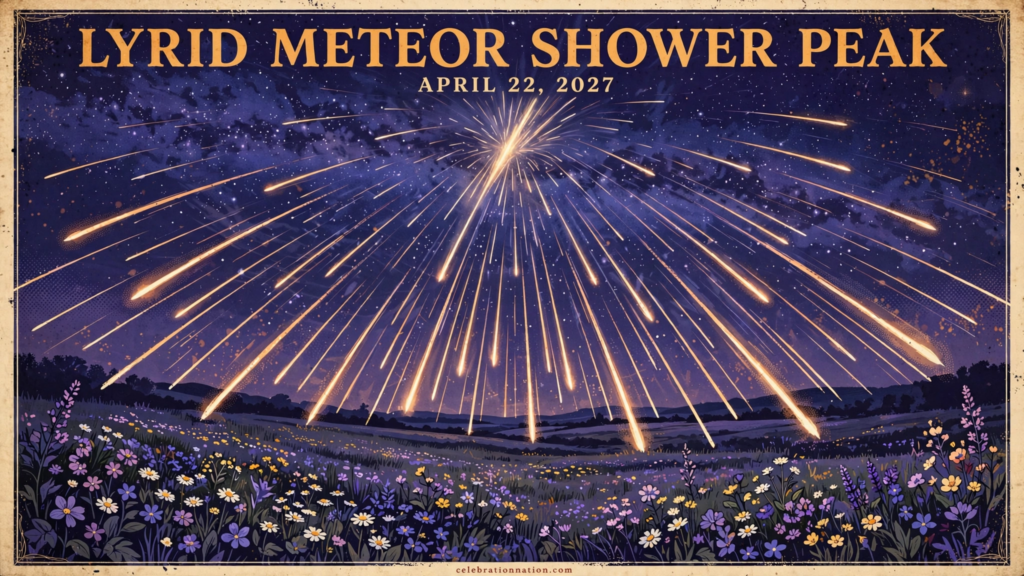
Lyrid Meteor Shower Peak
This year on April 22, the Lyrid meteor shower reaches its peak, continuing the oldest meteor tradition on record: people have watched these spring meteors for about 2,700 years. The first recorded sighting dates to 687 BC, when Chinese astronomers described stars falling like rain.
- Roots
- The Lyrids are debris from comet C/1861 G1 Thatcher, a long-period comet that takes about 415 years to orbit the Sun and was last seen in 1861.
- Also on Apr 22
- International Girls in Ict Day
- Hashtag
- #LyridMeteorShowerPeak
3 ways to celebrate
Watch After Midnight
The best viewing is after midnight and before dawn on April 23, when the radiant near Vega climbs higher in the sky. The predicted peak falls at 01:11 UTC, the evening of April 22 in Central Time.
Hide the Moon
A bright waning gibbous Moon competes with the shower in 2027 and washes out all but the brightest meteors. Put the Moon behind a building or a tree so its glare stays out of your eyes.
Find Vega First
The Lyrids radiate from the constellation Lyra near the bright star Vega. Locate Vega first, then scan the wide sky around it.
Plan ahead
Lyrid Meteor Shower Peak is observed on April 22 every year. Here is where it lands for the next ten years, handy for planners, marketers and party people.
Fast facts
The story
The Lyrids are the oldest known meteor shower, observed for about 2,700 years. The first recorded sighting was made by Chinese astronomers in 687 BC, who described stars falling like rain, and skywatchers have been looking for them every spring since.
Read the full story
The parent body is comet C/1861 G1 Thatcher, a long-period comet that takes about 415 years to orbit the Sun and was last seen in 1861. Its debris radiates from the constellation Lyra near the bright star Vega, arriving at about 30 miles (49 kilometers) per second. A typical peak produces about 18 meteors per hour under ideal conditions.
The Lyrids also keep a wild card in the deck. They occasionally surprise watchers with outbursts of up to about 100 meteors per hour; heavier displays were recorded in 1803 in Virginia, 1922 in Greece, 1945 in Japan, and 1982 in the United States. Nobody can promise an outburst, but the possibility hangs over every Lyrid night.
In 2027 the shower peaks on the night of April 22-23, with the predicted peak at 01:11 UTC on April 23, the evening of April 22 in Central Time. Viewing is challenging this year: the full Moon falls on April 20, so a bright waning gibbous Moon washes out all but the brightest meteors. Watch after midnight and before dawn, and put the Moon behind a building or a tree if you can.
Keep the party going
See the calendar



Celebrate every day, all year
Official gear from the people who track 1,700+ celebrations.
Browse the shop 2027 National Day Desk CalendarA new celebration every morning. Daily tear-off.
Never miss a reason to celebrate.
One quick morning email with today's celebrations, ideas and posters. Free, unsubscribe anytime.
🎉 You're on the list! Watch your inbox for The Daily Confetti.