
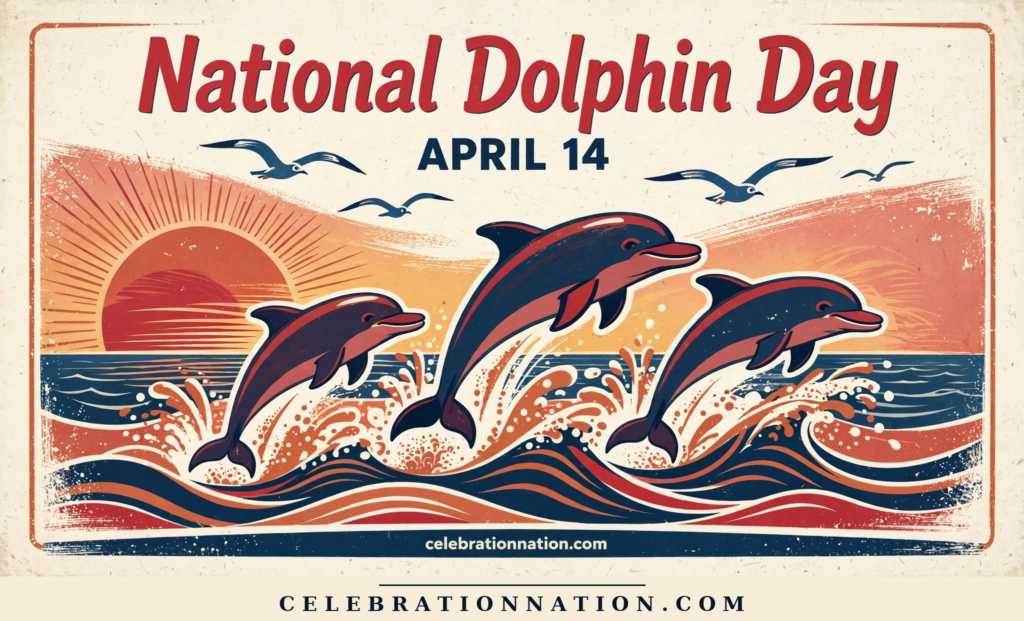
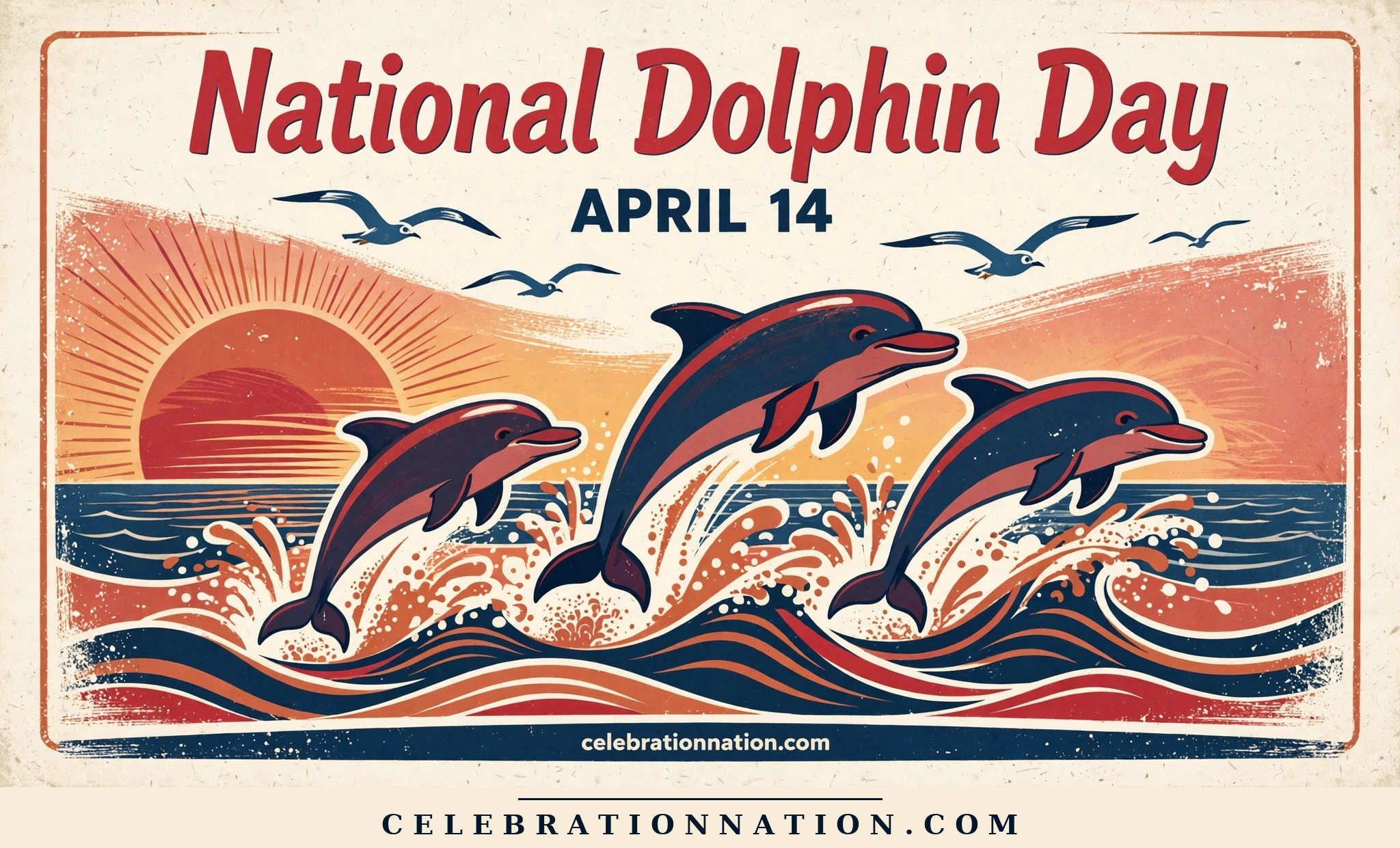
National Dolphin Day
National Dolphin Day on April 14 honors one of the most beloved marine mammals in the world — the playful, intelligent, highly social cetaceans that inhabit American coastal waters from Florida to Hawaii, Alaska to Maine. A day for conservation awareness, marine science education, and a renewed appreciation of the species most closely associated with human connection in the ocean.
- Vibe
- Playful & Protective
- Also on Apr 14
- International Moment of Laughter Day · World Chagas Disease Day · International Laverbread Day
- Hashtag
- #NationalDolphinDay
Ways to celebrate
See, learn, protect:
- 🐬 See dolphins responsibly. Ethical whale-watching tours in Florida, California, Hawaii, and the Outer Banks. Avoid tours that feed, touch, or swim with wild dolphins — all disrupt dolphin behavior.
- 🏖️ Clean a beach. Plastic pollution is a major dolphin threat. A 2-hour beach cleanup on April 14 is a direct conservation action.
- 📚 Read Susan Casey's 'Voices in the Ocean.' The definitive modern book on dolphin intelligence and human-dolphin relationships. Award-winning, accessible.
- 🎬 Watch 'The Cove' (2009). Academy Award-winning documentary about dolphin hunting in Japan. Confronting, essential, a defining dolphin-conservation film.
- 💰 Donate. Oceana, the Dolphin Research Center, or Marine Mammal Conservancy. Small direct-action charities do great work.
Make it your kind of celebration
Family
Dolphin-watching boat trip. Florida, Outer Banks, San Diego, Hawaii all have certified ethical tour operators. Life-changing for kids; memorable for adults.
Kids
Aquarium visit is fine for younger kids — but visit places with educational, rescue-focused programs (Georgia Aquarium, Monterey Bay Aquarium) rather than exploitation shows.
Couples
Sunset dolphin-watching cruise. Outer Banks (NC), Key West, Kona (HI), San Diego are all reliable. Romantic and awe-inspiring.
Office
Team donation to a marine-mammal charity in the company's name. Simple, meaningful, tax-deductible.
School
Great marine biology and ocean ecosystem lesson. NOAA has free classroom materials on dolphin biology and conservation.
Community
Local beach cleanup organized for April 14. Many environmental nonprofits coordinate events; easy to plug into.
Just me
An afternoon with 'Voices in the Ocean' or 'The Cove,' followed by a donation. Meaningful and contemplative.
Plan ahead
National Dolphin Day is observed on April 14 every year. Here is where it lands for the next ten years, handy for planners, marketers and party people.
Fast facts
The story
Dolphins are among the most studied, most documented, most culturally resonant non-human animals on Earth. There are 38 dolphin species worldwide, from the common bottlenose (the dolphin in Flipper, SeaWorld, and most American coastal waters) to the endangered vaquita (fewer than 20 remaining in the Gulf of California) to the orca (yes, the orca is technically a dolphin, the largest member of the family). Dolphins inhabit every major ocean basin and many major rivers (including the Amazon, Ganges, and Indus).
Read the full story
American waters host significant dolphin populations. The Atlantic and Gulf coasts have resident bottlenose populations. The Pacific Coast has bottlenose, common, Risso's, and Pacific white-sided dolphins. Hawaii has spinner, spotted, bottlenose, and rough-toothed dolphins, plus pilot whales and false killer whales (also dolphin family). Alaska has orcas and occasional Pacific white-sided dolphins. The total US dolphin population is thought to number in the hundreds of thousands.
Dolphin intelligence research has transformed modern biology. Dolphins have been documented: using sea sponges as tools to protect their rostra while foraging; recognizing themselves in mirrors (one of only a handful of species that can); learning and executing multi-step commands; communicating via signature whistles (like names); cooperating with human fishermen (Laguna, Brazil, has a 150-year-old dolphin-human cooperation tradition). Dolphins have the second-largest brain-to-body-mass ratio of any animal, smaller only than humans. The implications for how we understand non-human cognition are still being worked out.
American dolphin conservation is a substantial success story. The 1972 Marine Mammal Protection Act (MMPA) made it illegal to hunt, harass, or capture dolphins in US waters. Combined with the 1973 Endangered Species Act and subsequent tuna-fishing reforms (the 'dolphin-safe' tuna labeling system introduced in 1990), American dolphin populations have been stable or recovering for 40+ years. Active threats remain, plastic pollution, fishing gear entanglement, ship strikes, climate change, but compared to the 1960s catastrophes, the US has been a conservation model.
What 60 years of research has revealed:
Six American regions with resident wild dolphin populations:
Did you know?
The Navy has a Marine Mammal Program.
Since 1960, the US Navy has trained bottlenose dolphins for underwater military tasks, detecting sea mines, recovering lost equipment, marking underwater intruders. The program still exists, based in San Diego. About 85 active dolphin personnel.
Flipper was actually five different dolphins.
The 1964-1967 TV show 'Flipper' used five trained bottlenose dolphins, all female, all named 'Mitzi,' 'Scotty,' 'Kathy,' 'Patty,' and 'Squirt.' Richard O'Barry (who trained them) later became a leading anti-captivity activist, the subject of 'The Cove.'
Dolphins die in fishing nets.
Before the 'dolphin-safe' tuna reforms of 1990, an estimated 7 million dolphins died in US and international tuna-fishing nets from 1959-1990. Post-reform: approximately 1,000-2,000 per year, still too many, but a dramatic improvement. The dolphin-safe label works.
Bottlenose dolphins can live 40-60 years.
In the wild, documented lifespans of 40-60 years are common. In captivity, life expectancy is shorter (27 years median), another reason modern conservation emphasizes wild observation over captive display.
Keep the party going
See the calendar

Celebrate every day, all year
Official gear from the people who track 1,700+ celebrations.
Browse the shop 2027 National Day Desk CalendarA new celebration every morning. Daily tear-off.
Never miss a reason to celebrate.
One quick morning email with today's celebrations, ideas and posters. Free, unsubscribe anytime.
🎉 You're on the list! Watch your inbox for The Daily Confetti.