






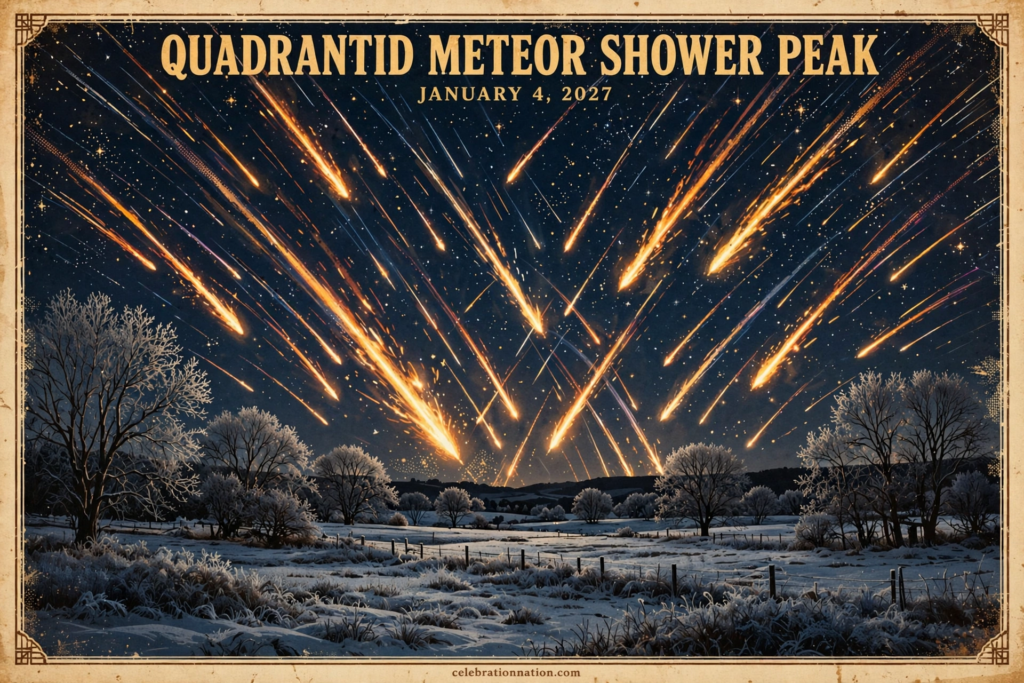
Quadrantid Meteor Shower Peak
This year on January 4, the Quadrantid meteor shower flashes to its peak and fades almost as fast, in one of the sharpest and briefest displays on the calendar. Blink and you could miss it, but those who time it right can catch one of the year's strongest showers.
- Roots
- The Quadrantids come from asteroid 2003 EH1, which may be the burnt-out remains of a comet recorded by East Asian astronomers about 500 years ago.
- Hashtag
- #QuadrantidMeteorShowerPeak
3 ways to celebrate
Time It Carefully
This peak lasts only a few hours, so timing matters more than usual. For North America, the hours before dawn on January 4 are the best window.
Look for Fireballs
The Quadrantids are known for bright fireballs despite the brief peak. Keep your gaze wide and your phone put away so the big ones cannot slip past.
Find the Radiant
The meteors radiate from the constellation Bootes, near the end of the Big Dipper's handle. Before dawn it stands high in the northeastern sky.
Plan ahead
Quadrantid Meteor Shower Peak is observed on January 4 every year. Here is where it lands for the next ten years, handy for planners, marketers and party people.
Fast facts
The story
The Quadrantids come from asteroid 2003 EH1, which astronomer Peter Jenniskens proposed as the shower's parent body in 2003. The object may itself be the burnt-out remains of comet C/1490 Y1, recorded by East Asian astronomers about 500 years ago, which would make the debris stream young and narrow, and the show intense but brief.
Read the full story
The shower carries a piece of lost astronomy in its name. It is named for Quadrans Muralis, a constellation that was dropped from the official list by the International Astronomical Union in 1922. The radiant now lies in the constellation Bootes, near the end of the Big Dipper's handle, but because the shower had already been named, the old name stayed.
The Quadrantids are active from December 28, 2026 to January 12, 2027, and are known for bright fireballs. The predicted maximum falls early on January 4 at about 03:30 Universal Time, which is 9:30 pm Central on January 3 and favors Europe and western Asia for the exact peak moment. Rates stay above half of maximum for only about 8 hours, compared with about two days for the Perseids.
For North America, the best time is the hours before dawn on January 4, when the radiant is high in the northeastern sky. In 2027 a thin waning crescent Moon will not spoil the view, so a clear, cold morning is all you need.
Keep the party going
See the calendar



Celebrate every day, all year
Official gear from the people who track 1,700+ celebrations.
Browse the shop 2027 Wall + Desk Calendar BundleCelebrate every day at home and at work.
Never miss a reason to celebrate.
One quick morning email with today's celebrations, ideas and posters. Free, unsubscribe anytime.
🎉 You're on the list! Watch your inbox for The Daily Confetti.