




World Sexual Health Day
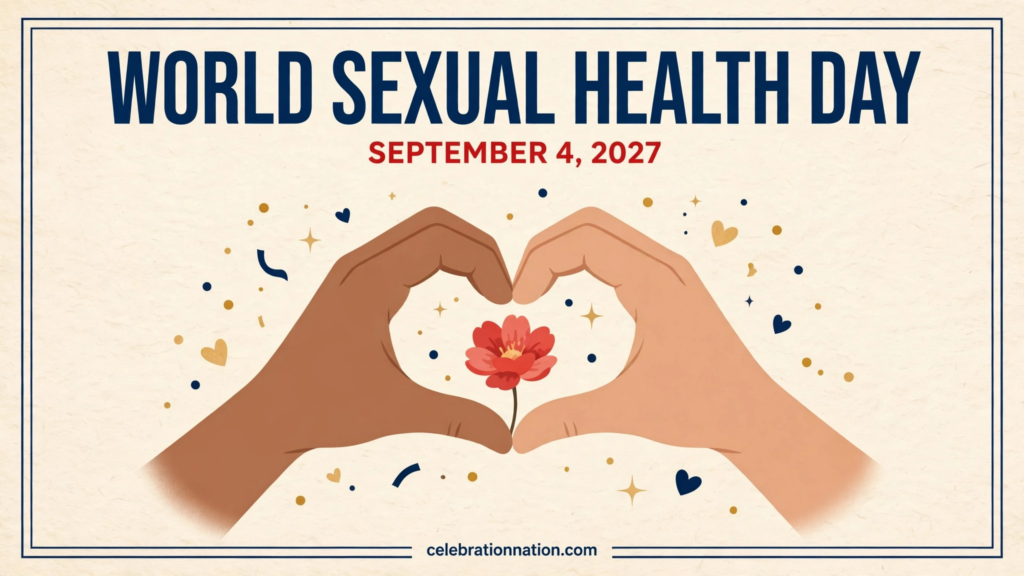
Every year on September 4, millions of people around the world join a conversation that was once whispered about, if it was discussed at all. World Sexual Health Day is a global invitation to talk openly, learn honestly, and treat sexual health as an essential part of overall well-being. In 2027 the day falls on a Saturday, September 4. It is a warm, stigma-free observance that belongs to absolutely everyone, and it starts with something simple: talking about it.
- Also on Sep 4
- Chianti Day · Food Bank Day · Lazy Mom’s Day
- Hashtag
- #WorldSexualHealthDay
WORLD SEXUAL HEALTH DAY
Every year on September 4, millions of people around the world join a conversation that was once whispered about, if it was discussed at all. World Sexual Health Day is a global invitation to talk openly, learn honestly, and treat sexual health as an essential part of overall well-being. In 2027 the day falls on a Saturday, September 4. It is a warm, stigma-free observance that belongs to absolutely everyone, and it starts with something simple: talking about it.
So what exactly is sexual health? The World Health Organization describes it as a state of physical, emotional, mental, and social well-being in relation to sexuality, and that definition is deliberately broad. Sexual health is not just about preventing disease or planning families. It touches medical care, education, relationships, and everyday behavior, and it asks for something deeply human in return: a respectful attitude toward sexuality, toward ourselves, and toward one another. Good sexual health means caring for your own physical and emotional well-being while honoring the dignity, boundaries, and rights of others.
The day was launched in 2010 by Rosemary Coates of Australia during her presidency of the World Association for Sexual Health (WAS), the international organization that still manages the observance today. Coates conceived the day with a clear objective: to spread the understanding that sexual health is a main component of our well-being, and that sexual health is only attainable through sexual rights. The first World Sexual Health Day was observed on September 4, 2010, under the theme “Let’s talk about it!”, and more than twenty-five countries took part in that very first year. One of those early events was an intergenerational discussion forum held at the Universidad Iberoamericana in Mexico City, where students, doctors, and advocates talked frankly across generations. Since then the day has grown into a global movement, with activities and campaigns now taking place in more than sixty countries.
Each year the day centers on a fresh theme, and the themes read like a map of what the world needs to discuss. Past themes have included consent, positive relationships, and “Sexual Justice: What Can We Do?” The 2026 theme, “Every Body,” carried a simple and powerful message: that health, dignity, respect, and access to appropriate care should not be privileges reserved for a few. The yearly themes keep the conversation current, letting each generation meet the day where it lives.
At the heart of the day sits a big idea: sexual health is a human right. WAS has long connected sexual health with sexual rights and human dignity, and its Declaration of Sexual Rights laid out what those rights include: equality and non-discrimination, autonomy and bodily integrity, freedom from all forms of violence and coercion, privacy, the highest attainable standard of health, accurate information, education, the choice of whether and when to have children, and access to justice. World Sexual Health Day calls on governments, organizations, healthcare providers, advocates, and the media to take those rights seriously, and to promote consent as a fundamental part of them. It is also, unapologetically, a day to celebrate the rights to pleasure, autonomy, and respect.
Why does a day like this matter? Because silence has a cost. When young people do not get honest, accurate information about their bodies and relationships, they face greater risks, from infections and unplanned pregnancies to coercion and abuse. When shame keeps adults from asking questions or seeking care, small concerns become big ones. World Sexual Health Day replaces that silence with something better: knowledge, compassion, and responsible conversation. It encourages societies to trade ignorance for learning, stigma for understanding, coercion for consent, and discrimination for equality. On September 4, the world is invited to do the bravest, kindest thing: start talking.
The tone of the day matters as much as its message. This is not a day of lectures or finger-wagging; it is a day of warmth. Organizers encourage events that feel welcoming: workshops, community gatherings, classroom discussions, and social media campaigns that meet people with kindness instead of judgment. Parents find age-appropriate ways to answer their children’s questions honestly. Young people find the language to ask for what they need. Healthcare providers, teachers, and advocates find new allies. And everyone is reminded of a truth that sounds simple and changes everything: our sexual health influences our overall happiness, our relationships, and our sense of self, so it deserves the same open, caring attention we give every other part of our health.
What began with a single theme has grown into a rich global calendar of its own. Each September 4, clinics host open houses, universities hold panel discussions, and advocates take to the streets and the airwaves with information people can trust. Social media fills with facts, personal stories, and reminders that seeking care is a sign of strength, not shame. And the work does not end when the day does: the conversations started on September 4 ripple outward into classrooms, doctor’s offices, and living rooms for the rest of the year. That is the quiet power of a day devoted to talking. One honest conversation can change a mind, and millions of them can change a culture.
THE STORY BEHIND WORLD SEXUAL HEALTH DAY
🎤 A Day That Began With Talk
World Sexual Health Day was launched in 2010 by Rosemary Coates of Australia during her presidency of the World Association for Sexual Health (WAS). Her goal was to spread the understanding that sexual health is a main component of our well-being, and that it is only attainable through sexual rights. The first theme, “Let’s talk about it!”, set the tone for everything that followed.
🌎 More Than Twenty-Five Countries in Year One
The very first observance on September 4, 2010, drew participation from more than twenty-five countries. Events included an intergenerational discussion forum at the Universidad Iberoamericana in Mexico City, where students and health leaders talked openly across generations. Today the movement reaches more than sixty countries.
🧭 A New Theme Every Year
Each year brings a fresh focus that reflects the moment: consent, positive relationships, and “Sexual Justice: What Can We Do?” among them. The 2026 theme, “Every Body,” affirmed that health, dignity, respect, and care belong to everyone, not just a privileged few.
⚖ Health Framed as a Human Right
WAS connects sexual health with sexual rights and human dignity. Its Declaration of Sexual Rights names equality, bodily autonomy, freedom from violence and coercion, privacy, accurate information, and education among the rights every person holds.
❤ What Sexual Health Really Means
The World Health Organization defines sexual health as a state of physical, emotional, mental, and social well-being in relation to sexuality. It is about respectful relationships, accurate information, and care, and it belongs to people of every age, background, and walk of life.
WAYS TO CELEBRATE
💬 Start an Honest Conversation
Channel the day’s first theme, “Let’s talk about it!”, and have an open, respectful talk with a partner, a friend, or a family member about consent, boundaries, and well-being. The most powerful observance can be a single honest conversation.
📖 Seek Out Accurate Information
Spend time with trustworthy sources, from your own healthcare provider to the World Association for Sexual Health, and refresh your understanding of sexual health and rights. Good information is one of the day’s core demands.
📢 Share the Message
Post a fact, a resource, or a local event using #WorldSexualHealthDay, or support an organization doing this work in your community. Every share helps replace stigma with understanding.
Celebrate World Sexual Health Day
On September 4, 2027, take part in the conversation the whole world is having. Talk, listen, learn, and help build a world where every person can seek health, dignity, and respect without fear or shame.
Plan ahead
World Sexual Health Day is observed on September 4 every year. Here is where it lands for the next ten years, handy for planners, marketers and party people.
Keep the party going
See the calendar


Celebrate every day, all year
Official gear from the people who track 1,700+ celebrations.
Browse the shop National Day Celebration Card GameA party in a box, any day of the year.
Never miss a reason to celebrate.
One quick morning email with today's celebrations, ideas and posters. Free, unsubscribe anytime.
🎉 You're on the list! Watch your inbox for The Daily Confetti.