






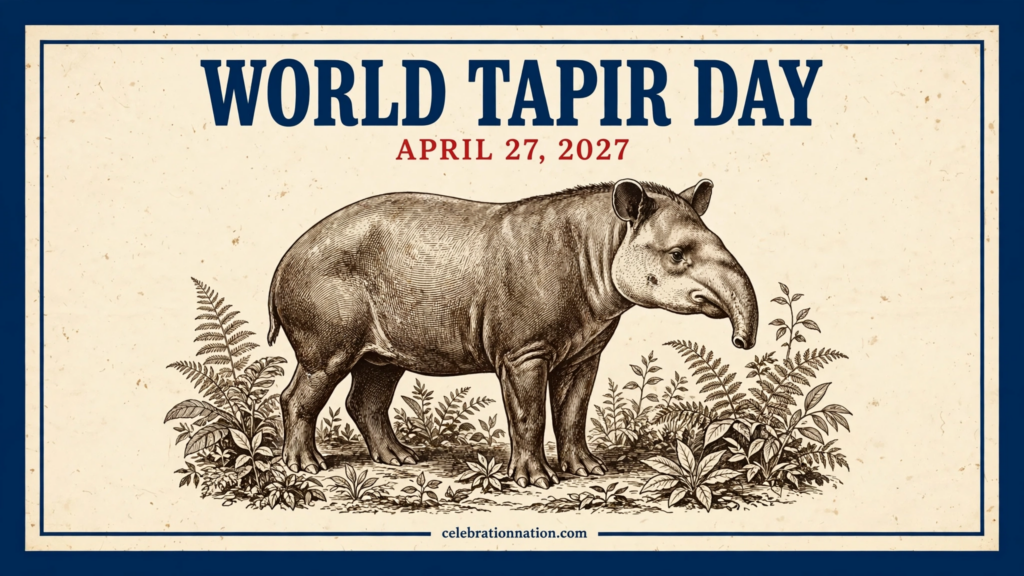
World Tapir Day
Every year on April 27, the forest's oddest-looking hero finally gets its moment in the spotlight. Tapirs are part elephant, part pig, part mystery, and completely lovable. These gentle giants have been wandering the planet for millions of years, quietly planting rainforests with every meal they eat. In 2027, World Tapir Day lands on Tuesday, April 27, and it is the perfect excuse to meet the marvelous mammal you never knew you loved.
- Also on Apr 27
- Gummi Bear Day · Prime Rib Day · Tell a Story Day
- Hashtag
- #WorldTapirDay
WORLD TAPIR DAY
Every year on April 27, the forest’s oddest-looking hero finally gets its moment in the spotlight. Tapirs are part elephant, part pig, part mystery, and completely lovable. These gentle giants have been wandering the planet for millions of years, quietly planting rainforests with every meal they eat. In 2027, World Tapir Day lands on Tuesday, April 27, and it is the perfect excuse to meet the marvelous mammal you never knew you loved.
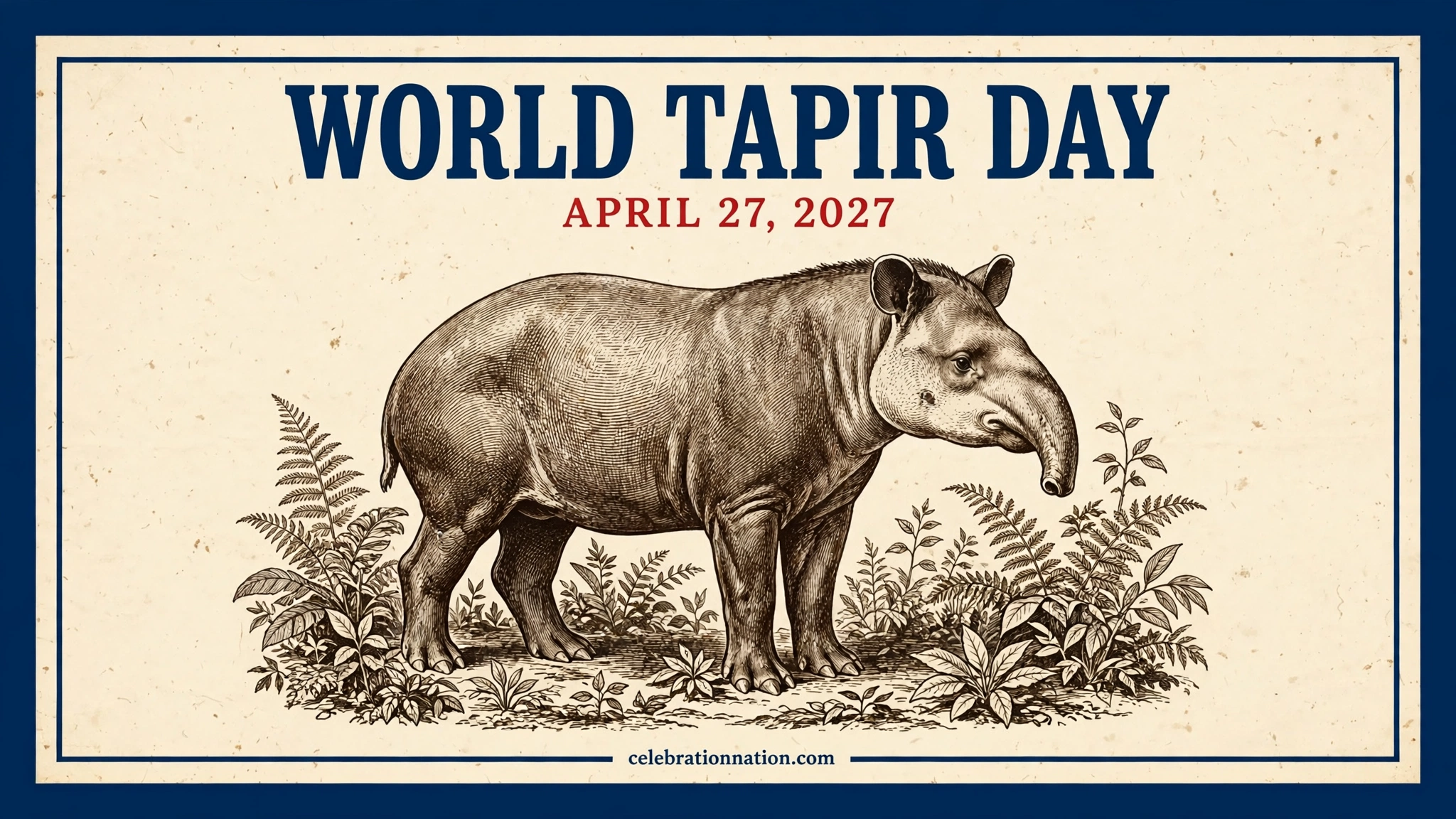
So what exactly is a tapir? Picture a sturdy, barrel-bodied mammal about the size of a small pony, with a coat that ranges from reddish brown to nearly black, and a short, flexible, prehensile snout that looks like a tiny elephant trunk. Tapirs are large herbivores that live in the jungles and forests of Central and South America and Southeast Asia, and they are close relatives of rhinoceroses and horses, not pigs, despite the resemblance. There are four living species: Baird’s tapir, the mountain tapir, the lowland tapir, and the Malayan tapir, the last one sporting a striking black-and-white pattern that looks like it was designed by a graphic designer with a sense of humor. The biggest tapirs stretch about 6.6 feet long and stand 3 feet high at the shoulder, yet they are famously shy and secretive, mostly solitary, and active at twilight and through the night. They are also superb swimmers, happy to cool off, munch aquatic plants, and even walk along riverbeds underwater like fuzzy little submarines. At the zoo, they are so often misidentified as anteaters, pigs, or small elephants that wildlife educators joke the tapir is nature’s best-kept secret.
Here is the thing about tapirs: they are not just cute, they are essential. Wildlife biologists call them the gardeners of the forest and count them as keystone species, meaning the health of whole ecosystems rests on their shoulders. Tapirs consume a vast array of fruits and plants, then disperse the seeds in their droppings over large distances, planting the next generation of trees and keeping the forest’s genetic diversity strong. When tapirs vanish from an area, it is often an early warning that the ecosystem is in serious trouble, because they tend to be the first species to disappear when humans encroach and the last to return when forests regrow. Tapirs are one of the oldest surviving genera in the animal kingdom, yet all four living species are now classified as vulnerable or endangered, threatened by deforestation, habitat fragmentation, mining, farming, and hunting. That is exactly why World Tapir Day exists: to pull these quiet giants out of obscurity and into the conservation spotlight where they belong.
World Tapir Day began with a media release on April 5, 2008, when the World Tapir Day Committee proudly announced the inaugural World Tapir Day to be observed on April 27, 2008. The goal was simple and urgent: raise awareness about the four tapir species, each one in decline and each one barely registering in the public’s collective consciousness. Since then the day has grown from a niche internet event into a genuinely global celebration, supported by groups like the IUCN Species Survival Commission’s Tapir Specialist Group and by zoos, wildlife organizations, and animal lovers in country after country. People mark the day by visiting zoos and wildlife sanctuaries that protect tapirs ethically, watching tapir documentaries, sharing tapir facts and photos on social media with the official @worldtapirday channels, and donating or volunteering with conservation organizations. The rallying cry says it best: saving tapirs helps to save the rainforest, saving rainforests helps to save the planet, and it all starts with learning the name of one funny-faced forest gardener.
THE STORY BEHIND WORLD TAPIR DAY
🐼 2008: The World Finally Notices
In early April 2008, the World Tapir Day Committee issued a media release announcing the inaugural World Tapir Day, to be observed on April 27, 2008. The day was established to raise awareness about the four species of tapir living in Central and South America and Southeast Asia, every one of them in decline and threatened by human activity such as mining, deforestation, farming, and hunting. At the time, tapirs were described as one of the least recognized animals on Earth, frequently misidentified by zoo visitors and almost invisible in children’s books and the media. The committee’s launch, with media contact Anthony Long and the official website tapirday.org, gave this overlooked genus its first-ever day on the global calendar, and the celebration has grown every year since.
🌱 Gardeners of the Forest
Tapirs earn their poetic nickname the honest way: by eating fruit all day. Because they consume such a wide variety of fruits and plants, they disperse seeds in their waste over large distances, which grows new trees and maintains the genetic diversity of the forest. Conservationists consider tapirs a keystone species, meaning their presence signals the health of an entire ecosystem, and their disappearance often marks a point of no return for the natural environment. Without tapirs, many tropical plants would lose their primary method of propagation, leading to thinner forests and a significant loss of biodiversity that affects countless other species, humans included. That is why the day’s organizers insist that saving tapirs helps to save the rainforest, and saving rainforests helps to save the planet.
🐺 Babies in Striped Pajamas
Tapir calves are born wearing what looks like camouflage pajamas: every baby tapir, across all species, sports a striped-and-spotted coat that hides it beautifully in dappled forest light. Grown tapirs are equally full of surprises. They make a high-pitched whistle that sounds like car brakes screeching, they love the water so much they will swim and even walk underwater along riverbeds, and they are mostly nocturnal, doing their forest gardening under cover of twilight. A group of tapirs is called a candle, which might be the most charming collective noun in the animal kingdom. And if you have ever looked at a tapir and thought elephant-pig, you are not alone: zoo visitors misidentify them so often that the confusion became one of the founding reasons for the day.
🌎 Four Species, One Fragile Future
There are four living tapir species: Baird’s tapir, the mountain tapir, the lowland tapir, and the Malayan tapir, and every one of them is now classified as endangered or vulnerable. Their biggest adversaries are the destruction and fragmentation of their habitats plus poaching, pressures that keep intensifying across their ranges. Tapirs are among the largest yet most secretive animals in their habitats, so their disappearance is often not noticed until it is too late. World Tapir Day asks the world to notice them now, while conservation can still work, by supporting the organizations, zoos, and sanctuaries that protect tapirs and the forests they garden.
WAYS TO CELEBRATE
📚 Become a Tapir Talent Scout
Learn three tapir facts that will win any trivia night, like the underwater riverbed walks or the candle of tapirs, and share them with friends alongside your favorite tapir photos on social media. Tag @worldtapirday so the global tapir community can cheer you on, and watch how fast your friends fall for that trunk.
🦁 Visit Tapirs in Real Life
Head to a zoo or wildlife sanctuary that protects tapirs ethically and spend some time at the tapir habitat, reading the signage and watching how they move, eat, and swim. Ask the keepers what you are seeing; they love talking about the animals everyone else walks past.
📖 Adopt a Tapir From Your Couch
Donate to a tapir conservation organization or the IUCN Tapir Specialist Group’s work, or simply watch a tapir documentary and learn about their behaviors, habitats, and the threats they face. Small actions, like learning and sharing, are exactly how an overlooked species becomes a protected one.
Celebrate World Tapir Day
So on Tuesday, April 27, give a little love to the tapir: part elephant, part pig, all gardener, and one hundred percent worth saving. Share a tapir fact, support the people protecting them, and remember that the funniest-looking animal in the forest might also be the most important one in it.
Plan ahead
World Tapir Day is observed on April 27 every year. Here is where it lands for the next ten years, handy for planners, marketers and party people.
Keep the party going
See the calendar



Celebrate every day, all year
Official gear from the people who track 1,700+ celebrations.
Browse the shop 2027 Wall + Desk Calendar BundleCelebrate every day at home and at work.
Never miss a reason to celebrate.
One quick morning email with today's celebrations, ideas and posters. Free, unsubscribe anytime.
🎉 You're on the list! Watch your inbox for The Daily Confetti.