

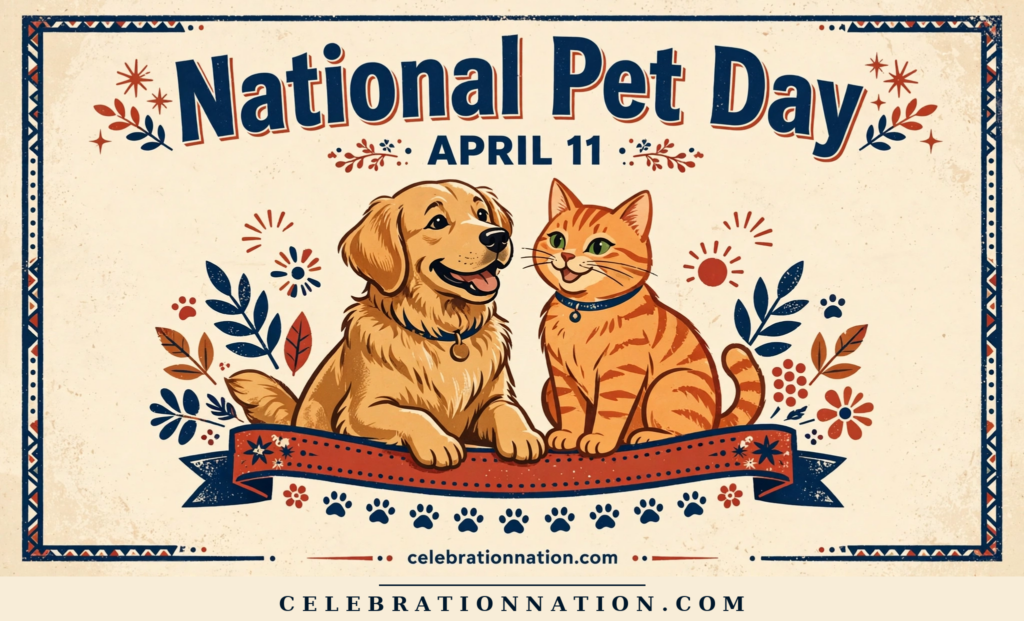
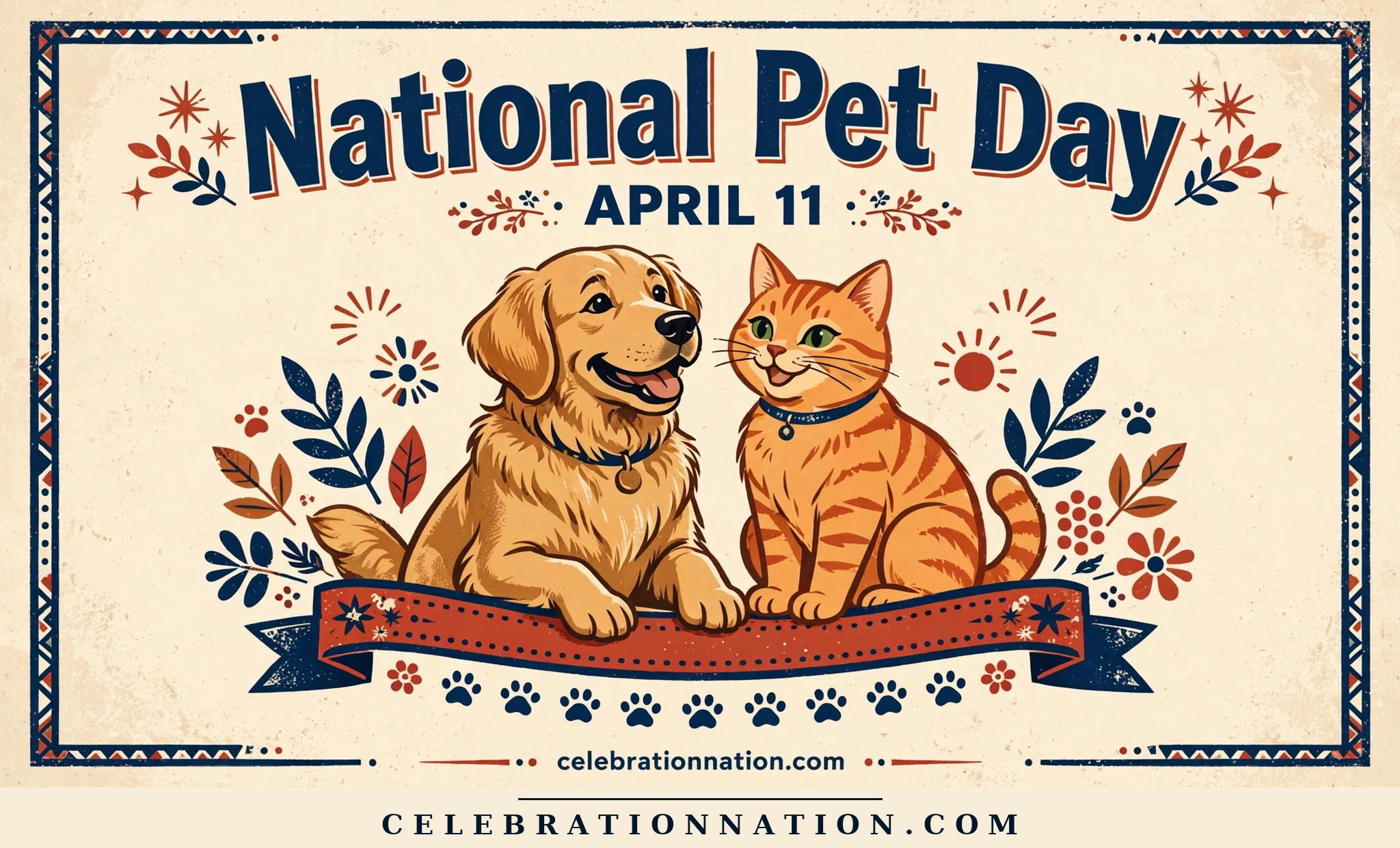
National Pet Day
National Pet Day on April 11 honors the 86 million American households that share their lives with pets — 65 million dogs, 47 million cats, plus birds, rabbits, hamsters, lizards, fish, and every other species that's found its way into American homes. Established in 2006 by animal-welfare advocate Colleen Paige. A day to celebrate the companionship, and also to remember the animals still waiting in shelters.
- Vibe
- Warm & Heart-Filled
- Also on Apr 11
- International Louie Louie Day · World Parkinson’s Day · Barbershop Quartet Day
- Hashtag
- #NationalPetDay
Ways to celebrate
Love them, help them, adopt:
- 🐶 Spend quality time with your pet. Extra walk, extra play, extra brushing. They notice.
- ❤️ Adopt or foster. Local shelters always need adopters and fosters. A life-changing, deeply American act of generosity.
- 💰 Donate to a shelter. The ASPCA, Best Friends Animal Society, local Humane Society, or your regional rescue. Small amounts help; larger ones transform.
- 📸 Take a photo. A good photo of your pet on their special day. Print it; frame it; share it.
- 🏥 Vet check-up. Schedule an annual vet visit if overdue. The single most meaningful gift for a pet's long-term health.
Make it your kind of celebration
Family
Kids + pets = pure joy. A family photo session, extra treats, longer walks. Classic family-togetherness day.
Kids
Teach kids about pet responsibility. Small daily care tasks (feeding, brushing, refilling water) build lifelong responsibility lessons.
Couples
For pet-owning couples: a photo session with your dog or cat. For non-pet-owning couples: consider adoption. A shared pet is a life commitment.
Office
Bring-your-pet-to-work day (where allowed). Office-wide morale boost; coordinate with HR first.
School
Great humane-education lesson. Kindness to animals is one of the most universally applicable ethical lessons for kids.
Community
Volunteer at a local shelter for the day. Dog-walking, cat-socializing, event help. High-impact, low-cost community service.
Just me
Extra time with your pet. Extra attention. They don't ask for much; they absorb more than we know.
Plan ahead
National Pet Day is observed on April 11 every year. Here is where it lands for the next ten years, handy for planners, marketers and party people.
Fast facts
The story
America is a nation of pet lovers. In 2024, 86 million American households (67%) reported having at least one pet, the highest rate ever recorded. 65 million households have dogs, 47 million have cats, plus millions more have birds, fish, rabbits, lizards, hamsters, guinea pigs, and every other domesticable species. Americans spent $147 billion on pets in 2023, larger than the toy, candy, or music industries. Pet-keeping has grown dramatically even as family sizes have shrunk; for millions, pets are family.
Read the full story
Pet-keeping in America has deep roots. Native American cultures kept dogs for hunting and companionship for thousands of years. Colonial American farms kept working dogs, barn cats, and domestic animals. Middle-class urban pet-keeping emerged in the mid-1800s, with veterinary medicine and professional pet products appearing in the 1880s. By the 1950s, pets had moved from outside to inside the American home, the modern 'pets as family members' model that still defines American attitudes.
National Pet Day was established in 2006 by Colleen Paige, a pet-lifestyle expert and animal-welfare advocate based in Washington state. Paige's specific focus from the start was shelter animals: the day was designed not just to celebrate existing pets, but to increase adoption awareness and reduce euthanasia. Approximately 6.3 million animals enter US shelters annually; ~4.1 million are adopted; ~920,000 are still euthanized. The "Adopt Don't Shop" movement has been a central theme of Pet Day since founding.
The scientific case for pet-keeping has also deepened. Dozens of peer-reviewed studies show pet ownership is associated with lower blood pressure, reduced cardiovascular risk, lower depression and anxiety, decreased loneliness, and improved heart attack recovery outcomes. Pet therapy is now used in hospitals, nursing homes, schools, and trauma rehabilitation. The ancient human-animal bond has been medically validated. Pets are not just companions, they are measurable health interventions. National Pet Day honors all of this: the joy, the companionship, the health benefits, the shelter animals still waiting. It has become one of the most widely observed pet-related American days.
How to turn Pet Day into real impact:
Six ways pets shape American life:
Did you know?
Goldfish are the most common American pet numerically.
Americans own roughly 139 million pet fish, far more than any other species by count. But most households treat a fish collection as one 'pet.' Dogs and cats are still the most-common household-level pets.
Presidents almost always have pets.
Every US President since Theodore Roosevelt has had a pet in the White House, with only one exception (Donald Trump, 2017-2021 and 2025-). Pets include dogs, cats, cows, alligators (John Quincy Adams), a pony (Caroline Kennedy), a parrot (Andrew Jackson).
Animal shelter euthanasia has declined dramatically.
In 1973, American shelters euthanized ~13.5 million animals per year. In 2023, that number was down to ~920,000, a 93% decline over 50 years. Awareness, spay/neuter programs, and 'Adopt Don't Shop' culture deserve credit.
The average American dog lives 10-13 years.
Breed matters: Chihuahuas average 15+ years; Great Danes average 8-10. Mixed-breed rescues often live longer than purebreds due to greater genetic diversity. The longest-verified pet dog lifespan is 29 years (Bluey, an Australian cattle dog, 1910-1939).
Keep the party going
See the calendar
Celebrate every day, all year
Official gear from the people who track 1,700+ celebrations.
Browse the shop National Day Celebration Card GameA party in a box, any day of the year.
Never miss a reason to celebrate.
One quick morning email with today's celebrations, ideas and posters. Free, unsubscribe anytime.
🎉 You're on the list! Watch your inbox for The Daily Confetti.