


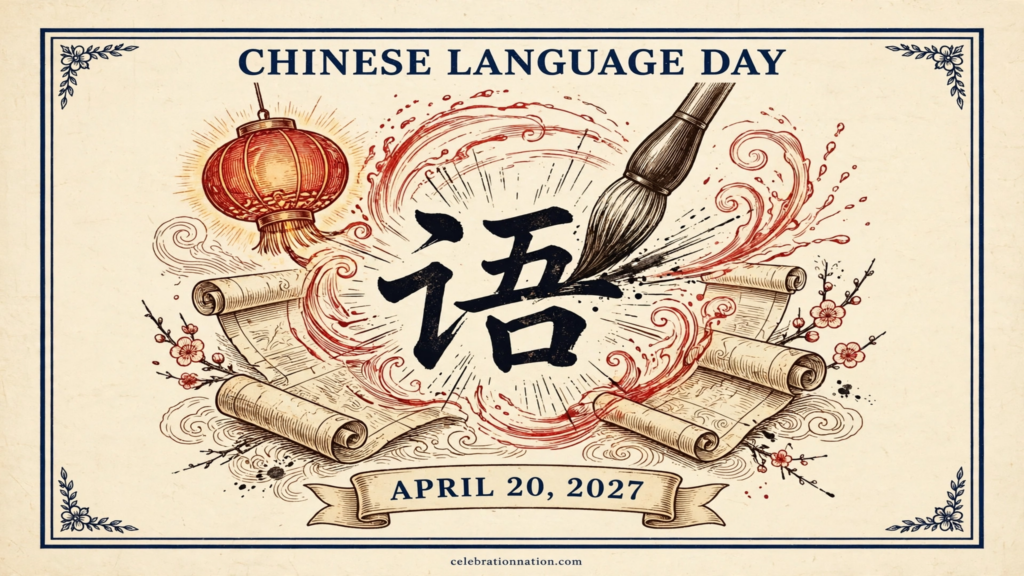
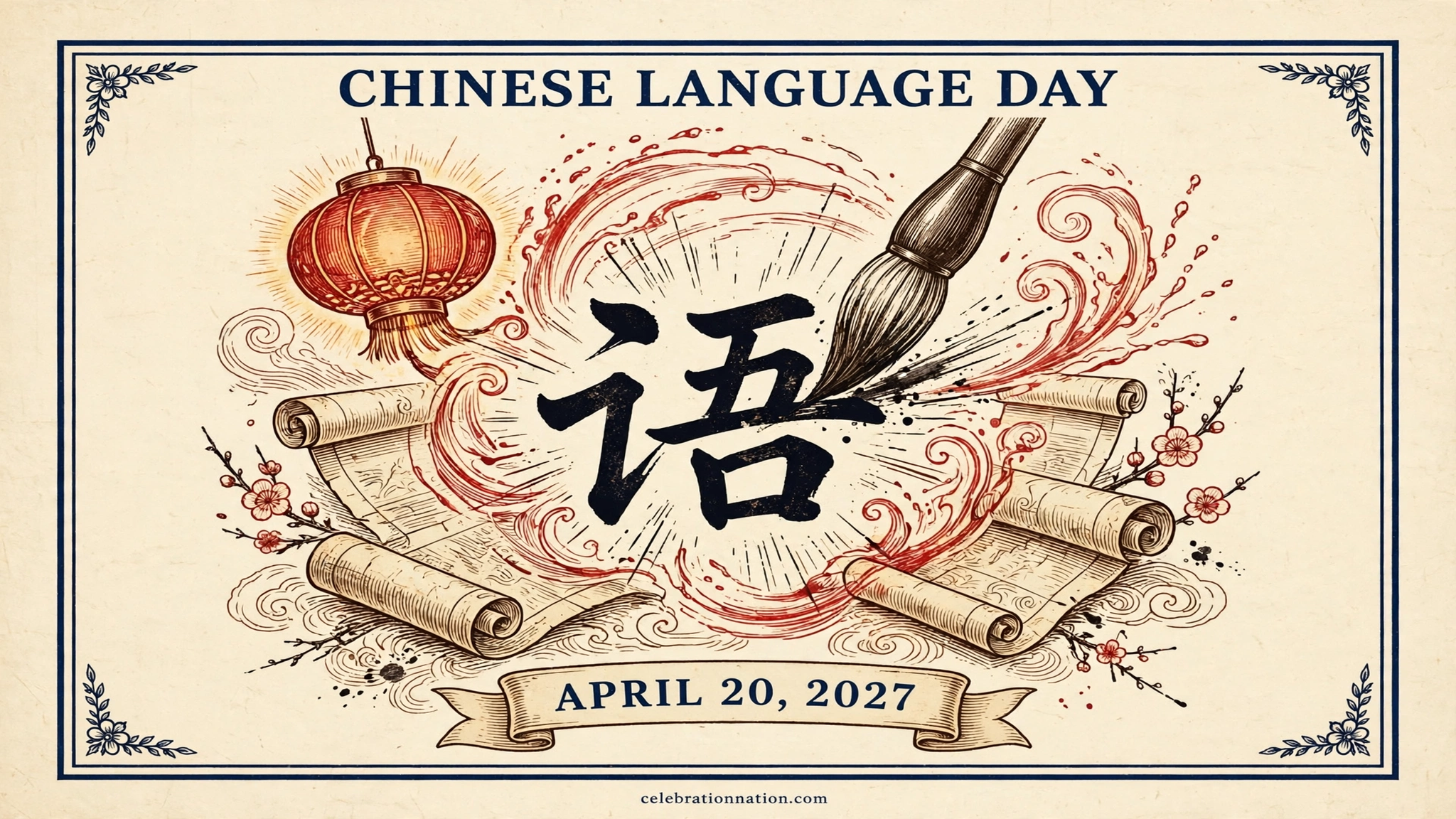
Chinese Language Day
Every year on April 20, five thousand years of written wisdom get their own day in the spotlight. Chinese Language Day turns the spotlight on one of humanity's oldest and most widely spoken languages. From the sweep of a calligraphy brush to the chime of a text message in Mandarin, April 20 celebrates the beauty, history, and living energy of Chinese.
- Also on Apr 20
- Cheddar Fries Day · Lima Bean Respect Day · Look Alike Day
- Hashtag
- #ChineseLanguageDay
CHINESE LANGUAGE DAY
Every year on April 20, five thousand years of written wisdom get their own day in the spotlight. Chinese Language Day turns the spotlight on one of humanity’s oldest and most widely spoken languages. From the sweep of a calligraphy brush to the chime of a text message in Mandarin, April 20 celebrates the beauty, history, and living energy of Chinese.
In 2010, the United Nations Department of Public Information, known today as the Department of Global Communications, established a series of language days to celebrate multilingualism and cultural diversity and to promote the equal use of all six of its official working languages throughout the organization. The idea grew out of an International Chinese Language Day initiative promoted by Chinese scholar Chen Entian, and it found a ready home at the UN. The very first Chinese Language Day was held on November 12, 2010. Beginning in 2011, the date moved to April 20, where it has stayed ever since, giving the world’s most widely spoken language a permanent springtime home on the calendar. The language days were conceived as a cultural counterpart to the UN’s formal work: while resolutions are negotiated in six languages, the language days celebrate what those languages carry, poetry, humor, philosophy, and song.
April 20 was not picked at random. It honors Cangjie, the legendary court historian of the Yellow Emperor who is credited with inventing Chinese characters some 5,000 years ago. The date roughly lines up with Guyu, the sixth of the twenty-four solar terms in the traditional East Asian calendar, which usually begins around April 20 and runs into early May. Guyu literally means “rain of millet,” a nod to the legend that when Cangjie completed his characters, the deities and ghosts wept and millet rained down from the sky. The choice delighted scholars, because Guyu is one of the most poetic of the solar terms, a moment when the natural world seems to exhale after spring’s first growth. In honoring Cangjie on this date, the UN linked a modern observance to a festival rhythm far older than the organization itself.
Few writing systems can claim such staying power. Chinese was designated one of the official languages of the United Nations in 1946, adopted as a working language of the General Assembly in 1973 and of the Security Council in 1974, with its use expanding significantly after the People’s Republic of China regained its UN seat in 1971. More than one billion people speak Mandarin Chinese as their first language, making it the most spoken of the UN’s languages. In 2009, UNESCO inscribed Chinese calligraphy on its Representative List of the Intangible Cultural Heritage of Humanity, recognizing the brush as both art and inheritance, a living practice passed from teacher to student for millennia. The practical scale of the UN’s commitment is staggering: every resolution, report, and official record must exist in all six languages, a translation effort without parallel anywhere on Earth.
Today the language bridges ancient and modern with remarkable ease. The same characters once carved into oracle bones now fly across smartphone screens in seconds, studied by more than 30 million learners outside China, with Chinese teaching supported in over 190 countries. The full written tradition holds tens of thousands of characters, though a few thousand suffice for everyday literacy, each one a small work of design refined over centuries. UN offices around the world mark April 20 with calligraphy demonstrations, poetry readings, and cultural performances, and each year brings a theme: 2025’s was “Chinese Language: A Gift Across Time and Space.” Chinese Language Day is an invitation to everyone, speaker or beginner, to pick up a brush, learn a greeting, and feel the pull of five thousand years of recorded thought.
THE STORY BEHIND CHINESE LANGUAGE DAY
📜 The Legend of Cangjie
Legend says Cangjie, historian to the Yellow Emperor, invented Chinese characters after studying the tracks of animals, the veins of leaves, and the patterns of nature itself. When he finished, the story goes, the heavens themselves reacted: deities and ghosts wept aloud, and grain fell from the sky like rain. Some versions say he was inspired by the tracks of birds and beasts pressed into the mud, others by the patterns of stars. Either way, the message endures: writing begins with paying attention. It is no wonder the United Nations chose Cangjie’s season for the language’s day.
🖌️ Guyu, the Grain Rain
The sixth solar term of the traditional East Asian calendar usually begins around April 20, marking the season when spring rains nourish the young grain and farmers watch the skies with hope. The word Guyu literally translates as “rain of millet,” echoing the legend of Cangjie’s invention. Farmers still watch Guyu closely, since the rains it brings decide the fate of the young crops. A language day tied to the farming year is a reminder that words, like grain, need the right season to grow.
🌏 One of Six
Arabic, Chinese, English, French, Russian, and Spanish are the six official languages of the United Nations, and the language days exist so that each one gets its moment in the sun. Chinese was designated an official language in 1946, became a working language of the General Assembly in 1973, and of the Security Council in 1974. The six language days are scattered through the year, each honoring the culture its language carries. Together they make the UN’s case that no single tongue owns the conversation, and April 20 is when the spotlight swings to Chinese.
⭐ Brushstrokes of Heritage
In 2009, UNESCO recognized Chinese calligraphy as Intangible Cultural Heritage of Humanity, honoring an art where a single character can carry meaning, music, and image all at once. Master calligraphers train for decades to make each stroke look effortless, and the tools are beautifully simple: brush, ink, paper, and patience. Students traditionally begin by grinding their own ink, a slow ritual that teaches patience before the first character is ever written. On April 20, the whole world is invited to admire the art, and the brave to try a stroke or two. Your first character will wobble, and that is entirely the point.
WAYS TO CELEBRATE
🖌️ Learn Five Characters at Home
Start with the essentials: 你好 (nǐ hǎo, hello), 谢谢 (xièxie, thank you), 爱 (ài, love), 好 (hǎo, good), and 中 (zhōng, middle). Grab a brush pen, follow a stroke-order guide slowly, and tape your best attempt to the fridge. Say each one aloud three times; tones matter, and your tongue will thank you for the workout. Five characters is a small start with a very long history behind it.
📜 Calligraphy Night with Friends
Lay out ink, brushes, and rice paper, pull up a stroke-order guide, and take turns writing the same character. Vote on the most elegant version, then frame the winner and hang it where everyone can see it. End the night by writing a word that describes your friendship and giving it to the host as a gift. Snacks are encouraged, perfection is not required, and the inky fingers are a badge of honor.
🌏 Explore Chinese Culture in the Community
Check your library, museum, or cultural center for April 20 events: film screenings, poetry readings, tea tastings, calligraphy workshops, or beginner Mandarin classes. UN offices and cultural institutes in many cities host open celebrations, and most welcome the simply curious with open arms and hot tea. If nothing is scheduled near you, stream a Chinese film with subtitles and cook dumplings at home; the day is about participation, not perfection, and every attempt counts.
Celebrate Chinese Language Day
Whether you write your first 你好 or your ten-thousandth, April 20 is a day to honor the language that has carried poems, philosophy, and family stories across five millennia. Pick up the brush. The page is waiting.
Plan ahead
Chinese Language Day is observed on April 20 every year. Here is where it lands for the next ten years, handy for planners, marketers and party people.
Keep the party going
See the calendar

Celebrate every day, all year
Official gear from the people who track 1,700+ celebrations.
Browse the shop 2027 National Day Wall CalendarGet the 2026 edition free. 1,700+ observances.
Never miss a reason to celebrate.
One quick morning email with today's celebrations, ideas and posters. Free, unsubscribe anytime.
🎉 You're on the list! Watch your inbox for The Daily Confetti.